
A CLIA lab director once summed up her operation as “four logins and a hope.” Sample tracking sat in one system, instrument output landed in another, documentation happened in a third, and a shared spreadsheet quietly held the whole thing together whenever the official systems refused to exchange data. That description fits a large share of US clinical and diagnostic labs today.
The lab software stack that was custom built at a time over fifteen or twenty years is now being asked to behave like a single connected system, and the push is coming from three directions at once: auditors who want a clean audit trail, AI tools that need structured data to work, and lab managers who are tired of exporting CSV files manually. This is the practical face of laboratory digital transformation, and it is playing out inside almost every hospital lab, reference lab, and diagnostics facility across the globe right now.
1. What Does a Typical Lab Software Stack Actually Look Like?
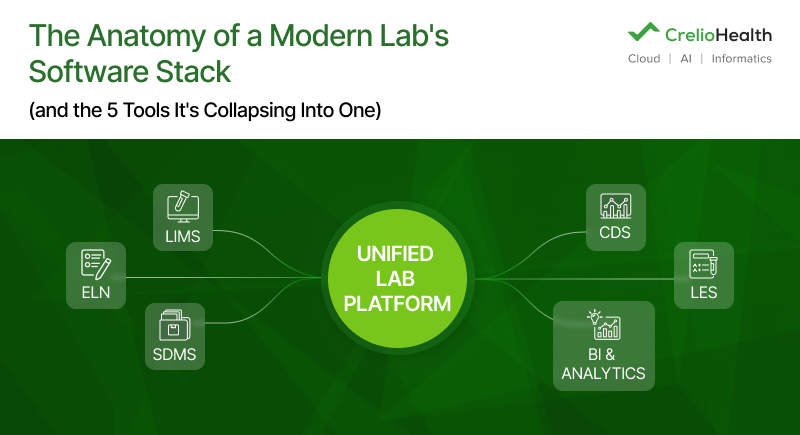
A lab software stack is the full set of digital systems a laboratory uses to manage samples, document experiments, capture instrument output, and stay ready for a CAP, CLIA, or ISO 17025 inspection. What some techs casually call their lab tech stack was rarely designed as a system. It was assembled one urgent problem at a time, usually with a different vendor solving each new headache as it appeared. In practice, that stack tends to include:
- Sample management software, typically a LIMS, tracking specimens from accessioning through the final report
- Documentation software, typically an ELN, recording protocols, observations, and experimental context
- Archive software, typically an SDMS, storing raw and unstructured instrument files
- Instrument software, typically a CDS, capturing chromatography and spectrometry output
- Custom scripts or middleware moving data between all four when nothing connects natively
The numbers confirm how common this patchwork is. Nearly 68% of laboratories in the US rely on digital systems to manage sample workflows, yet only about 59% have actually integrated their LIMS with analytical instruments, which means a meaningful share of labs are still bridging that gap by hand. The rest of this post walks through the five tools that built the classic stack, why each one showed up on its own, what is now pulling them together, and what a lab should check before it commits to unified laboratory informatics.
2. The 5 Tools That Make Up the Classic Lab Stack
Five categories of software show up again and again across clinical and diagnostic labs, each one built to solve a single piece of the puzzle rather than the whole picture:
| Tool | Stands For | What It Actually Does |
| LIMS | Laboratory Information Management System | Sample-centric tracking, workflow routing, and compliance reporting |
| ELN | Electronic Lab Notebook | Experiment-centric documentation of protocols and observations |
| SDMS | Scientific Data Management System | Archive for raw, unstructured instrument files |
| CDS | Chromatography/Instrument Data System | Captures and processes instrument-generated data |
| LES / Middleware | Laboratory Execution System or custom scripts | Orchestrates data flow between instruments and the rest of the stack |
I. Why Each Tool Emerged Separately
Fragmented lab software came together the way most lab infrastructure does, in reaction to whatever problem was most urgent that quarter, with whoever had budget approval at the time of making the call. A few patterns show up again and again when you trace how labs ended up:
- QC and R&D teams bought software on separate budgets, often years apart from each other
- Instrument vendors bundled proprietary data systems tied to their own specific hardware
- Compliance-driven LIMS purchases predate cloud computing and AI tooling by a decade or more
- Every new instrument usually meant a new point solution, not an extension of an existing one
That buying pattern is exactly why the global LIMS market is still growing fast even as consolidation talk picks up: MarketsandMarkets projects the market will grow from $2.88 billion in 2025 to $5.19 billion by 2030, a 12.5% CAGR, driven by compliance pressure, automation demand, and data integrity requirements rather than novelty purchases.
3. What’s Driving Lab Software Consolidation in Labs Right Now?
The core driver fits in one sentence: AI-native workflows and real-time data needs turn fragmented, siloed systems from an inconvenience into an operational bottleneck. This shift, generally described as lab software consolidation, is being pulled forward by four overlapping forces:
- AI and machine learning workflows need clean, queryable data, and lab data silos block that outright
- The cloud and SaaS shift removes the old technical excuse for keeping systems physically separate
- IT teams face rising total cost of ownership from patching and maintaining several point solutions at once
- Vendor market consolidation through M&A activity mirrors the same convergence happening inside individual labs
| Driver | What It Looks Like Day To Day |
| Cost / total ownership | Multiple vendor contracts, renewal cycles, and support tickets add up fast |
| AI readiness | Structured data becomes a prerequisite before any model can be trusted |
| Compliance and audit trail | One system of record beats reconciling logs across five separate tools |
| IT burden | Fewer integration points means fewer things that can break during a shift |
The gap between AI ambition and AI reality is exactly why this matters so much right now. A second annual survey from Cenevo of more than 110 life sciences professionals found only 5% are currently running AI agents in production, even though more than 60% are exploring or piloting the technology, and 58% cited privacy or security concerns as a barrier. A separate 2026 Deloitte survey found only 22% of life sciences leaders have successfully scaled AI, and just 9% reported meaningful returns. Fragmented data, not a lack of appetite, is the common thread behind both numbers.
4. How Are Legacy LIMS Systems Falling Short Today?
Set against that AI-readiness bar, legacy LIMS limitations become easy to name plainly:
- Client-server or on-premises architecture that resists real-time API access
- Proprietary middleware that requires custom integration work for every new instrument
- Interfaces built for a different decade, which slows onboarding and raises training costs
- Compliance workflows designed around paper-first processes, slow to adapt to iterative updates
I. The Hidden Cost of “Best-of-Breed” Stacking
Every additional point solution multiplies the places where an integration can quietly fail, and multiplies the vendors a lab must account for during an audit. Real implementation numbers back this up: each custom instrument interface can run $10,000 to $50,000 or more, and a large lab with many analyzers can spend well over $100,000 just on those connections. Across the market, labs commonly spend 4 to 5 times the sticker price of their LIMS software once implementation, training, and ongoing support are factored in, and enterprise deployments from established vendors can still take 6 to 18 months to go live.
4. What Does a Unified Laboratory Informatics Platform Look Like?
A unified laboratory informatics platform is a single platform, or a tightly integrated suite, that covers sample tracking, compliance documentation, data archiving, and instrument integration through one data model and one API layer. In practice, that means:
- A single data model instead of multiple databases that require sync or ETL work
- One API surface serving AI agents, dashboards, and instrument data at once
- Real-time, streaming instrument data instead of manual export-and-attach workflows
- Role-based access spanning QC, R&D, and IT from a single system of record
I. Interoperability Standards Enabling This Shift
The Allotrope Data Format provides shared insights for lab data, AnIML (the Analytical Information Markup Language) covers the data-at-rest layer with strong audit-trail support, and a 2026 ontology extension has formally aligned AnIML with Allotrope for cross-system use. SiLA 2 handles the communication layer, letting instruments, LIMS, and ELN systems discover and command each other without custom wiring. Together, these standards are the reason a converged platform is now an engineering choice rather than a research project.
5. The Architecture: How 5 Tools Collapse Into One Modern Stack
The table below is the simplest way to see the shift: the legacy, fragmented stack on one side, and the layers of a converged platform on the other. Nothing about the underlying work disappears. Sample management, documentation, data archiving, instrument data, and orchestration are all still happening. The change is that they now live in a single data model instead of five separate databases stitched together by whoever had time to write the export script that week.
| Legacy Fragmented Stack (Before) | Converged Platform Layer (After) |
| LIMS – sample tracking | Sample management layer |
| ELN – documentation | Documentation layer |
| SDMS – raw data archive | Data archive layer |
| CDS – instrument data | Instrument integration layer |
| Custom middleware/scripts | Native orchestration layer, one API surface |
Lab software stack consolidation of this kind is architectural, not just a matter of fewer vendor invoices. It changes what a lab can actually build on top of its data, from AI-assisted QC review to real-time dashboards that pull from every instrument on the bench.
6. What Should a Lab Evaluate Before Consolidating Its Stack?
Before committing to a unified platform, most lab directors find it useful to run through a short, scannable checklist covering the factors that matter most:
- Regulatory and compliance requirements, including GxP, ISO 17025, and CLIA audit trail needs
- Instrument integration coverage and how mature the platform’s API actually is in practice
- Migration path and data portability from every legacy system currently in use
- AI-ready lab data requirements: structured, queryable formats compatible with modern agent and analytics tools
- Workflow fit for the lab’s actual type, since discovery-stage R&D and regulated QC testing rarely need the same thing
I. Signs Your Lab Is Ready to Consolidate
- Staff routinely re-key the same result into two or three separate systems
- Manual exports and CSV attachments are the default way data moves between tools
- Audit prep takes days because records live in more places than anyone can list
- Onboarding a new instrument always turns into a multi-week integration project
7. What Are Modern Alternatives to Legacy LIMS?
Labs looking past their current setup are generally choosing from three categories of modern alternatives to legacy LIMS:
- Cloud-native unified platforms combining LIMS, ELN, SDMS, and analytics inside one cloud-native LIMS environment
- API-first lab software built for integration with instruments and AI agents from day one
- Open-source or composable stacks for labs that want flexibility over a single all-in-one suite
The right choice still depends on lab type. A regulated QC lab running validated methods needs a different depth of audit control than a discovery-stage R&D group experimenting with new assays every month, and both should weigh that difference carefully before switching from legacy LIMS to any single cloud lab informatics platform.
Frequently Asked Questions
Laboratory software stack consolidation raises real questions. Here are the ones lab directors ask before switching platforms.
What is a lab software stack?
It’s the mix of tools a lab runs day to day, usually a LIMS, ELN, SDMS, and CDS, to manage samples, log experiments, pull in instrument data, and stay audit-ready. Most labs didn’t choose this setup on purpose. It grew over time as new tools got bolted on, which is exactly why so many labs are now looking at unified laboratory informatics platforms instead.
What Does an LES Actually Do?
A Laboratory Execution System sits between your instruments and the rest of the stack, orchestrating data flow and enforcing step-by-step protocol compliance in real time. Where an ELN documents what happened, an LES controls what happens next, guiding technicians through validated procedures and catching deviations before they become audit findings. Many labs skip a dedicated LES and rely on custom middleware instead, which is exactly the kind of fragile, homegrown connective tissue that consolidation efforts are now replacing.
Why are labs consolidating their software tools right now?
Three reasons keep coming up in conversations with lab leadership: getting their data ready for AI, getting costs under control, and finally breaking down the data silos that build up when five tools don’t talk to each other. It’s less about chasing a trend and more about labs realizing their current setup can’t keep up with what they need next.
What happens to historical data when a lab switches to a new platform?
This is usually the biggest worry for lab managers. A good migration plan should pull your existing records, sample histories, and instrument data into the new system rather than leaving them stranded in the old one. If a vendor can’t give you a clear answer on how they handle historical data during migration, that’s a red flag. Look for cloud-native LIMS providers who treat this as a standard part of onboarding, not an afterthought.
What are good modern alternatives to a legacy LIMS?
Cloud-native LIMS platforms and laboratory operating systems are the main options worth looking at. The good ones are API-first, so they connect to your instruments without a ton of custom work, and they’re built to handle AI-ready data instead of bolting that on later. If your current LIMS feels like it’s fighting you at every turn, that’s usually the sign it wasn’t built for where labs are headed.
How long does a lab software consolidation project usually take?
It varies a lot depending on how many instruments you’re integrating and how much historical data needs to move over. Smaller labs with straightforward workflows might be up and running in a few weeks. Labs with complex compliance requirements or a lot of legacy instrument integration work can take a few months. The timeline matters less than picking a platform with a proven migration path, since a rushed switch causes more problems than a slow legacy system ever did.
Conclusion
None of this means every lab needs to rip out its LIMS next quarter. The five-tool stack did not happen by accident. Each tool solved a real problem at the moment it was bought, and plenty of labs are still running that setup without issue. What has changed is the cost of staying fragmented: AI tools now expect clean, structured data, auditors expect one clear trail instead of five, and newer platforms are shipping in weeks what used to take a year to implement. The practical next step for most lab directors is not a full platform migration project. It is running the evaluation checklist above against their own stack this quarter, and being honest about what it turns up.

