
LIMS has become a catch-all term for lab software, and that is the core problem with the category today. A designation built in the 1980s for single-instrument, single-department sample tracking now covers inventory, compliance documentation, and reporting. In practice, those functions ended up spread across five or six disconnected tools, each with its own login. That mismatch has shaped how labs budget for technology, how vendors position their platforms, and how directors judge whether their stack can support AI, multi-site scale, or genuine digital lab transformation. Most conversations framed as LIMS modernization still treat the fix as a newer interface or a cloud migration, when the underlying issue is architectural: legacy LIMS systems were never built to share data with the tools around them. A real lims modernization framework has to move past that mental model toward a smart lab operating system built on shared data from the start.
The healthcare industry needs a term that matches what modern lab operations actually run on, and terms like lab operating system, scientific data operating system, and smart lab operating system are catching on for the same reason. This article sets out what a lab operating system is, why LIMS architecture no longer describes it, and what a real lims modernization framework requires once the category itself has changed.
Table of Contents :
1) What Do People Actually Mean When They Say ‘LIMS’ Today?
2) Why Doesn’t ‘LIMS’ Describe What Modern Labs Run On Anymore?
3) What Is a Lab Operating System?
4) How Is a Lab Operating System Different From a Traditional LIMS?
5) Why Is This Shift Happening Now?
6) What Does ‘LIMS Modernization’ Actually Mean If the Category Itself Is Changing?
7) How Should a Lab Evaluate Whether It Needs a Lab Operating System?
8) Conclusion
What Do People Actually Mean When They Say ‘LIMS’ Today?
The honest answer is that most teams no longer mean one system. They mean a cluster of tools that grew up around an original LIMS install and never got consolidated.
- Origin story: LIMS emerged in the 1980s and 1990s as a narrow sample-tracking tool, built for single-instrument, single-department labs running one linear workflow.
- Scope creep: Over three decades, the term absorbed inventory management, ELN-adjacent note-taking, compliance documentation, and reporting dashboards it was never designed to hold.
- Label outlived design: Labs kept saying “LIMS” even as they bought standalone tools for each new need, because no better shared vocabulary existed.
- Budget blind spot: The “LIMS market” figure quoted in vendor decks usually undercounts real lab software spend, since ELN, inventory, QMS, and scheduling tools are tracked and sold as separate categories.
By the numbers
The global LIMS market was valued at $2.08 billion in 2025 and is projected to reach $3.48 billion by 2033, growing at a 6.60% CAGR, with life science companies accounting for roughly 41% of that spend (Grand View Research, 2026). That figure alone does not capture what a lab spends stitching together the ELN, inventory, and QMS tools that sit outside the “LIMS” line item.
Why Doesn’t ‘LIMS’ Describe What Modern Labs Run On Anymore?
A modern lab’s actual operating layer spans sample tracking, experiment documentation, inventory, instrument data, and compliance, and LIMS was only ever built to own one slice of that. This is why a simple lims system upgrade rarely solves the underlying problem: the missing pieces sit outside the LIMS entirely.
- Most labs run LIMS, an ELN, an inventory system, and a stack of spreadsheets side by side, each with its own database and its own login
- Every new instrument or assay type tends to show up with its own software, adding a fresh silo instead of extending one that already exists
- IT teams end up maintaining point-to-point integrations between systems that were never designed to talk to each other in the first place
- Data ownership gets blurry fast, since the same sample can carry different metadata in the LIMS record, the ELN entry, and the inventory log
This fragmentation was tolerable when workflows were linear, single-department, and data volume was low enough for manual cross-checks. It breaks down under multi-modal experiments that touch sample, sequencing, imaging, and compliance data at once, under throughput that outpaces manual reconciliation, under multi-site collaboration where every location runs its own version of the same fragmented stack, and under AI-readiness requirements that need one coherent data structure rather than five incompatible ones. That is the plain comparison of a modern ai-enabled lims vs traditional systems, and it is why a traditional lab data management system alone no longer clears the bar for cross-domain work.
I. The Cost of Lab Data Silos
More than half of lab technicians report losing significant time to manually moving information between systems rather than acting on it, and only a small fraction say they can analyze experimental data without that step first. In U.S. medical labs specifically, nearly half of lab professionals (48%) still report that LIS or EHR data integration issues are actively holding back digitization efforts, according to the 2025 MLO State of the Industry Survey.
| Friction point | What it costs the lab |
| Manual data entry across LIMS, ELN, and inventory | Technician hours diverted from testing |
| Re-verifying results across systems | Slower turnaround time |
| Reconciling billing with test records | Unbilled or delayed claims |
| Cross-checking compliance documentation | Audit prep that starts weeks early |
What Is a Lab Operating System?
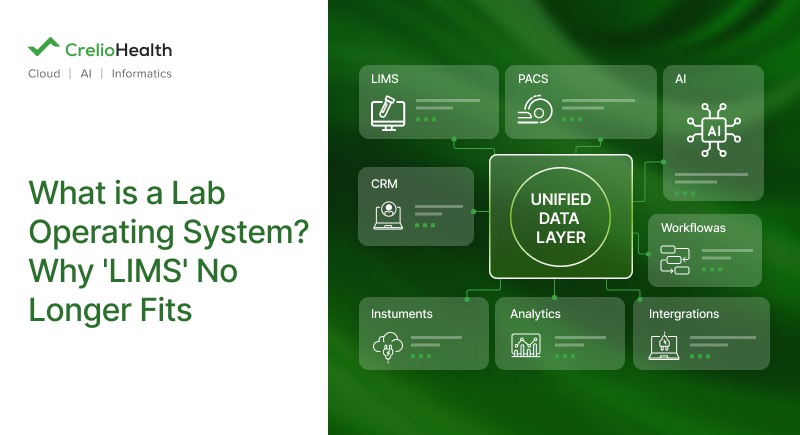
A lab operating system is the unified data and workflow layer that coordinates every lab process and application, the way a computer operating system coordinates hardware and programs, built on one data model instead of a stitched-together stack, giving the lab a single unified lab operations platform for daily work.
- Borrowed analogy: A lab operating system manages resources and coordinates processes by giving every application a shared layer to work from instead of a private copy of the truth.
- Not a suite: A “platform” bundles modules under one login while each still stores data separately; a lab operating system makes sample, experiment, inventory, and compliance data seamlessly shared operations.
- Core components: A unified lab data integration platform, connected sample, experiment, inventory, and compliance workflows, and an open integration layer for instruments and analytics tools.
Practical use case for end users: One search answers a cross-domain question instead of requiring a scientist to manually join data across three or four systems.
Picture a technologist trying to answer something as simple as: how many samples from analyzer 3 failed QC in the last 90 days, and which protocol were they run under? On a fragmented stack, that means opening the LIMS to check sample status, the ELN for protocol details, and the inventory system for freezer location, then lining the three up by hand in a spreadsheet. On a lab operating system, it’s one query because sample, protocol, and inventory already live as connected records rather than three separate ones. That is the practical payoff of proper lims eln integration once the whole stack sits on a shared data model.
DefinitionA lab operating system is the coordination layer that lets sample data, test records, inventory, instrument output, order billing, and compliance documentation function as one connected system instead of five separate ones. |
How Is a Lab Operating System Different From a Traditional LIMS?
A traditional LIMS, or traditional lab data management system, is a system of record for samples. A lab operating system is the connective layer that makes every system of record interoperable in real time.
Dimension |
Traditional LIMS |
Lab Operating System |
| Architecture | Built from modules bolted on over time | One native, unified data model (cloud or on-prem) |
| Data Model | Data siloed in tables tied to its own schema | Sample, protocol, and inventory treated as shared entities across applications |
| Extensibility | Customization means custom development and waiting on IT | Open APIs built for extension, actual LIMS/ELN integration without a developer for every request |
| User Experience | Different login for every module | One coherent workspace across functions |
| Integration Approach | Point-to-point integrations bolted on after the fact, maintained by IT | Open integration layer designed for instruments and analytics tools from the start |
| Scalability | Strains under multi-site, multi-instrument, or high-throughput growth | Built to handle multi-site collaboration and rising data complexity natively |
| Compliance/Data Exchange | Often still tied to legacy HL7 v2 interfaces | Positioned to support FHIR-based data exchange |
| Best Fit | Small lab, one core workflow, low data complexity, no near-term AI plans | Multi-site/multi-instrument labs, labs applying AI/ML, frequent cross-domain questions |
| Answering Cross-Domain Questions | Requires opening multiple systems (LIMS, ELN, inventory) and manually reconciling in a spreadsheet | One query, since records already live as connected entities |
The natural pushback is that this just sounds like LIMS, ELN, and inventory in one dashboard. The distinction is architectural, not cosmetic. Bundling three tools under one brand and one login still leaves three databases underneath, each with its own schema and its own version of a sample record. A genuine lab OS collapses that into one shared data model, so there is only one version of the record to begin with. A standalone LIMS still makes sense for a single site, single-workflow lab with low data complexity and no near-term AI plans. A lab OS earns its added complexity for multi-site, multi-instrument labs, labs applying AI or ML to their data, or labs where cross-domain questions come up weekly. In blunt terms, the modern ai-enabled lims vs traditional systems debate always comes back to whether the underlying scientific data operating system is one shared model or five stitched-together ones.
Why Is This Shift Happening Now?
AI-driven analysis and higher-dimensional medical data make fragmented systems a structural bottleneck, not just an inconvenience.
- Rising Data Complexity: Multi-modalities, high-throughput instrumentation, and datasets that span sample, sequencing, imaging, and compliance boundaries at once. This alone would strain a fragmented stack. Layer AI on top and the strain becomes a hard limit.
- AI/ML as a Forcing Function: Cross-domain pattern detection needs one coherent data layer to function at all. Five formats to reconcile first isn’t a workaround; it’s a dead end.
- Regulatory Pressure: Auditors increasingly expect traceable, end-to-end data lineage rather than reconciled exports assembled before an inspection. That expectation is only getting harder to meet as teams spread across locations.
- Talent and Collaboration Pressure: Distributed, multi-site teams need one unified lab operations platform, sometimes described as a unified lab data integration platform, instead of a different tool stack at every location, if they want to function as a genuinely connected laboratory.
Genomic data illustrates the scale of the shift. Global genome-sequence data storage needs are estimated at roughly 40 exabytes by 2025, according to the National Human Genome Research Institute.
| Data Driver | Recent Figure |
| Genome-sequence storage needs, worldwide | Approximately 40 exabytes by 2025 |
| Multi-omics market growth | $3.1B in 2025 to $9.8B by 2033, 15.3% CAGR |
| LIS market growth, integrated and AI-enabled platforms | $2.4B in 2026 to $4.0B by 2036, 5.3% CAGR |
| EHR and payer data exchange standard | Shifting from HL7 v2 to FHIR-native architecture |
On the compliance side, LIMS and LIS platforms are increasingly expected to support FHIR-based data exchange rather than older HL7 v2 interfaces, as every major EHR network and payer system moves toward FHIR-native architecture. That shift is part of why the future of LIMS looks less like a single application and more like a connected layer that speaks the same data language as everything around it, and it is why the modern ai-enabled lims vs traditional systems comparison keeps ending in favor of the shared model.
What Does ‘LIMS Modernization’ Actually Mean If the Category Itself Is Changing?
Modernization is not a newer LIMS interface or a cloud migration. It is a decision about whether to keep stitching point solutions together or move to a unified operating layer. A workable lims modernization framework starts by naming that decision explicitly rather than dressing up a lims system upgrade as strategic transformation.
Common narrow path:
- Replatforming the same LIMS architecture to the cloud without changing the underlying data model
- Adding a bolt-on integration layer or middleware on top of existing silos
- Swapping one LIMS vendor for another without changing how data is structured or shared
Why it fails to fix anything: A cloud-hosted LIMS with a modern interface can still store sample, inventory, and compliance data in separate tables underneath.
Real LIMS modernization requires:
- A unified data model where sample, protocol, instrument, and inventory data exist as connected entities, not separate databases
- An open integration layer with published APIs, so new instruments and analytics tools connect without custom development each time
- An incremental, modular migration path, so labs are not forced into a disruptive big-bang cutover
The stakes of getting this wrong are real. Across industries, 70% to 79% of legacy modernization projects fail to meet their goals, exceed budget, or are abandoned outright, largely because teams replatform old architectures instead of addressing the underlying data model. Labs evaluating a LIMS refresh should treat that figure as a warning against any project that changes the interface without changing the architecture. The distinction between a shallow lims system upgrade and a genuine lims modernization framework shows up most clearly on that architectural question.
The one question that cuts through all vendor pitchesCan this system answer a cross-domain question (sample plus protocol plus instrument plus inventory) natively, without a manual export and a spreadsheet join? If the answer requires opening three tools, the project is not modernization. |
How Should a Lab Evaluate Whether It Needs a Lab Operating System?
If answering a simple cross-domain question requires opening three systems and a spreadsheet, the lab has already outgrown a standalone LIMS and probably needs a unified lab operations platform or full smart lab operating system to bring the pieces back together. That gap tends to show up in the budget long before anyone names it. Labs comparing what LIMS vendors quote versus what they actually end up paying often find the difference comes down to exactly this kind of fragmentation.
I. Signals that it’s time to switch:
- Multiple disconnected tools already in daily use across LIMS, ELN, inventory, and spreadsheets, with no real lims eln integration between them
- Staff regularly cross-reference data manually between systems to answer routine questions
- The lab is scaling to multiple sites, instrument types, or testing volumes that strain current workflows
- Leadership has near-term plans to apply AI or ML to lab data
II. Signal a standalone LIMS still works:
- Single site, single core workflow, and low data complexity
- If manual cross-checking is occasional (not a daily routine) and current compliance needs are already met
III. When a vendor evaluation is warranted, here are the four critical questions to address:
Run your daily workflows against a real list of business-critical lab data questions your vendor should be able to answer instantly.
- Is the data model genuinely unified, or are these modules sold under a single brand while still storing data separately?
- How open is the integration and API layer for instruments and third-party analytics tools, does it support real lims eln integration, and does it actually deliver lab data interoperability instead of one-off point connections?
- What does an incremental migration path look like, and can it start without a full cutover?
- Does the platform support FHIR-based data exchange, not just legacy HL7 v2 interfaces?
Conclusion
LIMS describes a system of record. A lab operating system describes the coordination layer that modern labs actually run on, and the gap between those two things keeps widening as data complexity, AI readiness, regulatory expectations, and distributed teams put more pressure on fragmented stacks. None of this means every lab needs to rip out its LIMS tomorrow. It means the label a lab uses for its own technology should match what that technology is actually being asked to do. The clearest test is the one raised earlier: if answering a routine cross-domain question takes three logins and a spreadsheet, the lab has already outgrown the term it is using. That is the working definition of a scientific data operating system: one place where sample, protocol, instrument, and inventory data behave as a single unified lab data integration platform instead of a stitched-together traditional lab data management system.
Run your own stack against that test. If the gap is real, it is worth a closer look at what a lab operating system approach could change in your daily operations, starting with the one workflow costing you the most manual reconciliation right now.
Frequently Asked Questions
Still weighing whether a Lab Operating System is worth the shift from your current setup? These are the questions labs ask most often before making the move-
I. Is a lab operating system the same thing as a LIMS?
No. A LIMS is a system of record, typically for samples, that can sit inside a lab OS as one connected component. A Lab Operating System sits a level above it. It’s the layer that ties the LIMS together with your ELN, inventory, and instruments, so they’re all talking to each other instead of sitting in separate silos.
II. What should a lab look for before choosing a Lab Operating System platform?
Three things matter more than the feature list: how well it integrates with instruments and systems you already have, how much configuration it needs versus how much comes ready to use, and whether your team can actually adopt it without a six-month change-management project. A platform that looks powerful in a demo but takes a year to configure isn’t solving the problem; it’s just delaying it.
III. How long does it take to implement a Lab Operating System?
It depends on scope. Labs that plan for a modular, incremental migration can connect systems in stages rather than forcing a big-bang cutover that halts operations. A narrow deployment connecting a few instruments and one workflow can be running in a matter of days. Full-scale adoption across multiple departments, with integrations and staff training, more realistically takes a few weeks. Labs that try to do everything at once tend to stall out; the ones that succeed usually start with one high-pain workflow and expand from there.
IV. Does a Lab Operating System help with compliance and audit readiness?
Yes, and it’s often the reason labs make the switch. Because the lab operating system captures workflows, instrument activity, and sample handling in one connected place, audit trails end up more complete by default, not because someone remembered to log something, but because the system was tracking it anyway. That said, it’s not automatic compliance. The lab still has to configure its workflows to match the regulations it’s actually held to.
V. Do independent labs need a lab operating system?
Often not. A standalone, well-configured LIMS can be sufficient for a single site running one core workflow with low data complexity and no near-term AI plans. The calculus changes once a lab adds sites, instrument types, or AI ambitions.

