
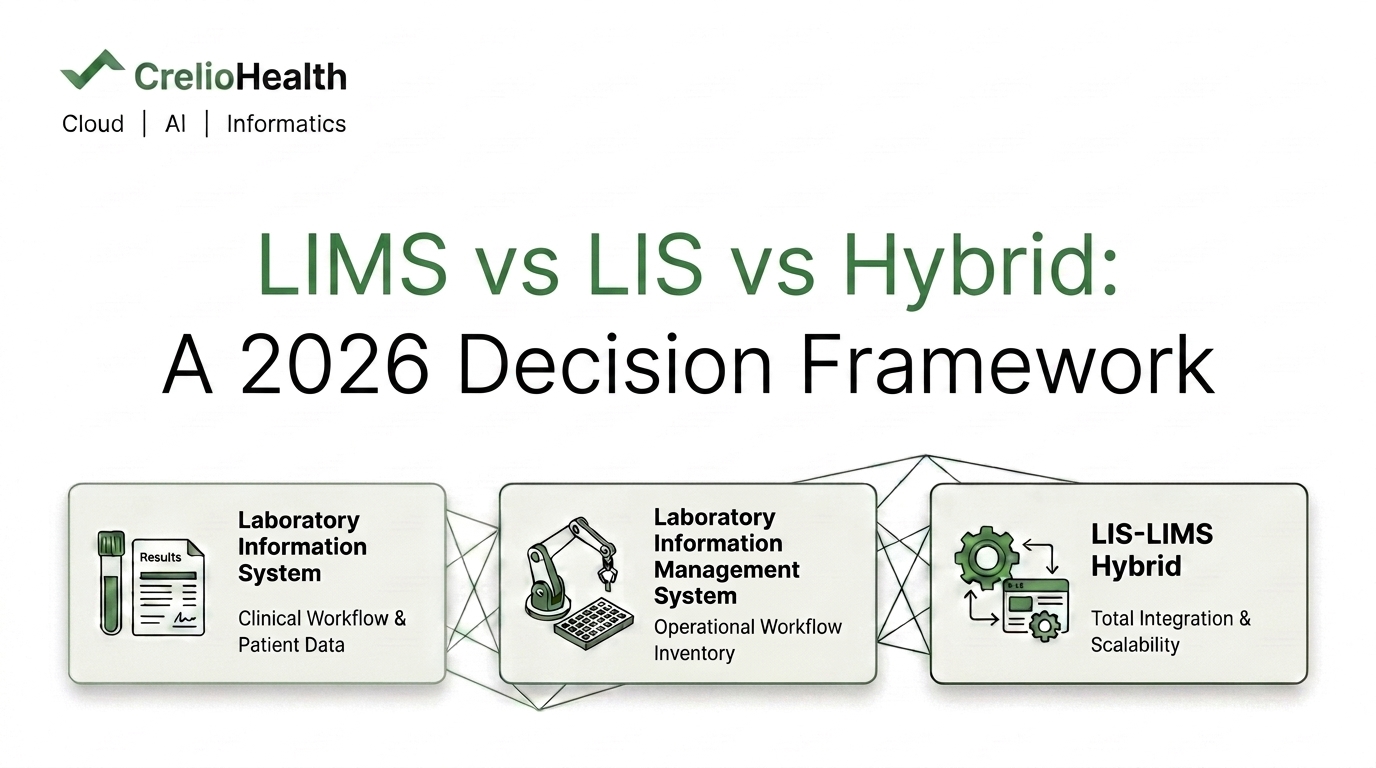

LIMS and LIS are two terms that vendors use interchangeably in their marketing. Lab decisions as buyers go wrong for a simple reason: they assume LIS vs LIMS are different names for the same product. They aren’t. One is built around patient data, whereas the other is built around sample data, and confusing the two has led labs to buy systems that can’t do what they need.
This guide, written for lab directors, IT leads, and procurement teams, is designed to resolve that confusion for good. By the end, you’ll know exactly which architecture fits your lab’s test volume, patient-reporting obligations, and regulatory scope, backed by a five-question framework to confirm it. If you’ve already decided which system fits, jump straight to our LIMS vendor selection checklist to start evaluating vendors.
What Is the Difference Between LIS and LIMS?
LIS manages the flow of patient and clinical data. LIMS manages the flow of samples and lab operations data. A LIMS-LIS hybrid integrates both. Everything else in this article builds on that one sentence.
The clearest way to tell them apart is to ask what each system is organized around. LIS is organized around the patient record: an order comes in, a result goes out to a physician, and the billing follows. LIMS is organized around the sample record: as a specimen arrives, it moves through a defined workflow and generates data that has to be traceable and auditable. A hybrid platform is organized around both, in a single database, so neither record has to be handed off to a second system to get the other half of the job done.
What Is a Laboratory Information System (LIS)?
The concept of the Laboratory Information System revolves around the patient’s records. It receives physicians’ orders, monitors the patient’s demographic data, returns the results to the ordering physician, and interacts with the billing system in the majority of cases.
Core LIS functions include order management, clinical result reporting, patient demographic management, and HL7/FHIR-based interoperability with hospital EHR systems. A well-implemented LIS also handles critical value alerts and physician portal access, because in a clinical setting, a result that doesn’t reach the right doctor fast enough is a result that doesn’t matter.
Independent LIS systems are still central to the work of clinical diagnostics laboratories, hospital laboratories, and reference laboratories, with their primary role being that of performing tests ordered by clinicians for patients. According to independent industry estimates, the presence of independent LIS systems is greater than 60% in clinical laboratories associated with hospitals in the US, with most of the remaining percentage being accounted for by HIS modules and hybrid systems, thereby implying the significance of patient management records for laboratory operations.
What Is a Laboratory Information Management System (LIMS)?
LIMS is built around the sample. It doesn’t ask “which physician ordered this” so much as “where is this specimen right now, what’s been done to it, and can I prove that in an audit?” It’s a fundamentally different job.
Core LIMS functions include sample and specimen tracking, chain-of-custody documentation, quality control management (including Westgard rules and proficiency testing), instrument interfacing, reagent and inventory tracking, and detailed data audit trails built for scientific and regulatory scrutiny rather than clinical care.
LIMS platforms dominate in research labs, pharmaceutical and biotech labs, industrial and environmental testing labs, and high-volume diagnostic operations where sample throughput and traceability matter more than physician-facing reporting. If your lab’s output is data rather than a clinical conversation with a treating physician, a LIMS is likely doing or should be doing the heavy lifting.
What Is a LIMS-LIS Hybrid System?
A hybrid platform does both jobs in one system: it manages the patient record and the sample record without handing data between two separate vendors through a middleware layer. Chain-of-custody tracking, QC automation, and instrument interfacing sit alongside physician order entry, clinical result reporting, and payer billing, in a single database, a single audit trail, and a single login.
Large diagnostic networks have moved toward hybrid platforms for a straightforward reason: running a separate LIS and LIMS means running two vendor relationships, two upgrade cycles, and an integration layer that has to keep working every time either vendor pushes an update. One term worth clarifying here: “integrated LIMS” is sometimes used by vendors to describe a LIMS with add-on clinical modules, which is not the same as a true hybrid built from the ground up to handle both data models natively. Ask any vendor using the word “integrated” what, specifically, is integrated, and how.
Table 1: LIS vs LIMS vs LIMS-LIS Hybrid – Key Dimensions for Diagnostic Labs (2026)
| Dimensions | LIS | LIMS | LIMS-LIS Hybrid |
|---|---|---|---|
| Primary function | Patient & clinical workflow management | Sample, test & data management | Both — integrated clinical & sample ops |
| Typical lab types | Clinical diagnostic, hospital lab | Research, pharma, industrial, high-volume Dx | Large diagnostic networks and reference labs |
| Patient Data Management | ✅ Core capabilities | ⚠️ Limited or add-on | ✅ Full |
| Sample lifecycle tracking | ⚠️ Basic | ✅ Core capabilities | ✅ Full |
| Physician Order Management | ✅ Core capabilities | ❌ Typically absent | ✅ Full |
| Result reporting (clinical) | ✅ HL7/FHIR native | ⚠️ May require integration | ✅ Native |
| QC & proficiency testing | ⚠️ Basic | ✅ Advanced | ✅ Full |
| Regulatory focus | HIPAA, CLIA, CAP | ISO 17025, FDA 21 CFR Part 11 | HIPAA + CLIA + 21 CFR Part 11 |
| Billing integration | ✅ Strong (payer interfaces) | ⚠️ Limited | ✅ Native |
| EHR / EMR integration | ✅ Native | ⚠️ Via Middleware | ✅ Native |
| Multi-site management | ⚠️ Varies by vendor | ⚠️ Varies | ✅ Designed for networks |
| Implementation complexity | Moderate | Moderate–High | High |
| Best for new labs? | Diagnostic labs under 200 tests/day | Specialty/research labs | Labs over 500 tests/day or multi-site |
CrelioHealth analysis, 2026.
Which Labs Need LIS, LIMS, or Hybrid?
The simplest rule cuts through most of the confusion: if your lab receives physician orders and sends results back to clinicians, you need LIS functionality. If your lab’s primary output is data rather than patient care, a LIMS may be sufficient on its own.
Use-Case Decision Guide – 5 Lab Types
- Small independent diagnostic lab (under 200 tests/day, physician referrals). Your entire business runs on receiving orders and returning results fast and accurately. Verdict: LIS.
- Mid-size clinical lab with in-house QC and 3–5 analyzers. You still need clinical reporting, but growing QC demands and multiple instrument interfaces are starting to strain a basic LIS. Verdict: LIS, moving towards Hybrid as volume grows.
- Specialty labs like toxicology, genetics, pathology with complex, multi-step workflows. Chain-of-custody and advanced QC modules matter as much as, or more than, physician-facing reporting. Verdict: LIMS, or Hybrid if you also report directly to referring physicians.
- Research or pharma labs with no patient-facing results. There’s no physician order to manage and no patient portal to maintain. Verdict: LIMS.
- Enterprise diagnostic network with multiple collection centres. You’re running patient-facing clinical operations at a scale where a middleware layer between two systems becomes a liability. Verdict: Hybrid.
Three questions settle most cases quickly:
- Do you manage patient records directly?
- Do you send results to physicians?
- Do you manage multi-site operations at volume?
Answer yes to the first two, and you need LIS at minimum. Answer yes to all three and hybrid is almost always the more defensible long-term choice.
For toxicology labs specifically, the calculus shifts further toward chain-of-custody and forensic-grade audit trails. See our detailed breakdown of LIMS requirements for toxicology labs to see how that use case differs from general clinical testing.
Feature-by-Feature Comparison: What Each System Includes
The clearest differentiator, stated directly: LIMS does not natively include physician order management or patient demographics. These are LIS-native features. LIS typically does not include advanced chain-of-custody sample tracking or ISO 17025 QC modules. These are LIMS-native. Everything else is a matter of depth, not presence.
| Features | LIS | LIMS | Hybrid |
|---|---|---|---|
| Physician Order Management | ✅ | ❌ | ✅ |
| Patient demographics | ✅ | ❌ | ✅ |
| Clinical result distribution | ✅ | ⚠️ | ✅ |
| Payer billing interface | ✅ | ❌ | ✅ |
| Chain-of-custody tracking | ⚠️ | ✅ | ✅ |
| Sample aliquoting | ⚠️ | ✅ | ✅ |
| Reagent/inventory management | ❌ | ✅ | ✅ |
| Advanced QC (Westgard rules) | ⚠️ | ✅ | ✅ |
| ISO 17025 audit trails | ❌ | ✅ | ✅ |
| Instrument interfacing | ✅ | ✅ | ✅ |
| HL7 messaging | ✅ | ⚠️ | ✅ |
| Unified patient + sample view | ❌ | ❌ | ✅ |
Direct Answer: LIMS does not typically include physician order management, patient demographic management, or direct payer billing interfaces. These are LIS-specific functions, and if a vendor tells you their LIMS handles all three natively, ask to see it configured for a real physician-order workflow before you believe them.
Regulatory & Compliance: How Requirements Differ by System
Compliance obligations follow the data, not the software category. Patient data triggers HIPAA. Clinical testing triggers CLIA and CAP. Research and pharma testing trigger 21 CFR Part 11 and ISO 17025. Whichever system you choose has to be validated against the specific obligations your lab actually carries — not a generic checklist.
- LIS compliance requirements: HIPAA patient privacy protections, CLIA clinical testing standards, CAP accreditation workflow documentation, and state lab licensing requirements where applicable.
- LIMS compliance requirements: FDA 21 CFR Part 11 electronic records and signatures, ISO 17025 for testing and calibration laboratories, and GxP standards for pharmaceutical labs.
- Hybrid compliance: A hybrid platform has to satisfy all of the above simultaneously. Before signing, confirm the vendor holds validation documentation for both the LIS-side and LIMS-side compliance tracks separately. A vendor that can show you a CLIA-ready clinical module and a 21 CFR Part 11-ready sample module is in a different category from one that simply asserts “we’re compliant.”
HL7 and FHIR interoperability deserve a specific mention here: they’re not just integration conveniences. Structured, standards-based data exchange is itself a compliance asset, because it creates a defensible audit trail for how patient data moved between systems, exactly what a CAP inspector or HIPAA auditor wants to see documented.
A distinction that matters more than most buyers realize: a standalone compliance system handles audit documentation only. A LIMS with compliance modules enforces compliance rules at the workflow level, preventing non-conformance rather than just recording it after the fact. For CAP-accredited labs, that difference determines whether your next inspection finds a paper trail or finds a system that stopped the error before it happened.
Advantages and Disadvantages of Each System
LIS (Laboratory Information System)
Pros:
- Patient-centric design built for clinical reporting
- Native HL7/FHIR interoperability
- Strong payer billing integration
- Physician portal ready out of the box.
Cons:
- Limited sample-level analytics
- Often needs middleware for advanced QC
- Not built for research or pharma-grade sample management
LIMS (Laboratory Information Management System)
Pros:
- Granular sample tracking and chain-of-custody
- Advanced QC automation
- ISO 17025 and 21 CFR Part 11 ready
- Instrument-agnostic by design
Cons:
- Not built for physician-facing clinical workflows
- Limited or absent billing integration
- Clinical labs typically need an LIS overlay to use one standalone
LIMS-LIS Hybrid
Pros:
- One system, one data model, one audit trail
- Eliminates the middleware layer between LIS and LIMS
- Scales across both patient and sample workflows at once
Cons:
- Higher implementation costs
- Longer go-live timelines
- Greater vendor lock-in risk if the platform doesn’t support clean data export
Total Cost of Ownership: LIS vs LIMS vs Hybrid
Hybrid systems cost more upfront, but less over five years. They eliminate the integration middleware and the duplicate vendor support contracts that standalone systems accumulate as a lab scales. Standalone LIS or LIMS platforms are typically cheaper to implement initially, but that gap narrows and often reverses once integration and scaling costs are added in.
- LIS TCO factors: implementation timelines of roughly 60–90 days for a standalone deployment, per-user licensing, HL7 integration costs with your EHR or HIS, and ongoing support SLAs.
- LIMS TCO factors: instrument interface build costs, which commonly run $20,000–$60,000 depending on analyzer count and complexity; validation fees to bring the system into 21 CFR Part 11 compliance; and custom report configuration for specialty workflows.
- Hybrid TCO factors: a higher Year 1 investment, offset over Years 2 through 5 by the absence of duplicate vendor support contracts, a single upgrade cycle instead of two, and unified staff training instead of parallel training programs for two systems.
How to Choose in 2026: A 5-Question Decision Framework
Every version of this decision comes down to the same five questions. Answer them honestly for your lab, in order, and the right architecture becomes obvious.
Q1: Does your lab send results directly to physicians or patient portals?
If yes, you need LIS functionality. If no, a standalone LIMS may be sufficient.
Q2: Does your lab bill payers – Medicare, Medicaid, or private insurance directly?
If yes, you need LIS or hybrid; payer billing integration is an LIS-native capability. If no, LIMS alone can likely handle your operational needs.
Q3: Does your lab run more than 500 samples per day, or manage a multi-site network?
If yes, hybrid is very likely the right long-term choice. The operational cost of running two systems at that scale outweighs the higher upfront hybrid investment.
Q4: Are you operating under 21 CFR Part 11 or ISO 17025, research, or pharma testing?
If yes, you need LIMS or a hybrid platform with validated compliance modules for those specific standards.
Q5: Do you already run a standalone LIS and want to add LIMS-level sample management?
Before ripping out an existing LIS, evaluate certified middleware or a hybrid migration path. A working LIS with a genuine sample-management gap is not automatically a reason to replace the whole system.
Once you know which architecture fits your lab, the next step is shortlisting vendors that actually deliver on these requirements on paper and in practice. Use our LIMS vendor selection checklist to pressure-test every vendor against compliance depth, integration quality, scalability, and financial transparency, and see 10 critical questions to ask your LIS or LIMS vendor before you sign anything.
Frequently Asked Questions
What is the main difference between LIS and LIMS?
LIS manages patient and physician-facing clinical workflows for orders, results, and reporting. LIMS manages sample and lab operations data for tracking, testing, and quality control. The distinction comes down to what the system is organized around: the patient record, in the case of LIS, or the sample record, in the case of LIMS. Most confusion in the market comes from vendors using the terms loosely in marketing material.
Can a LIMS replace a LIS for clinical diagnostic labs?
Generally, no unless the LIMS vendor has built genuine, native LIS functionality into the platform. Physician order management, HL7-based result distribution, and HIPAA-compliant patient privacy modules are LIS-specific capabilities that most standalone LIMS platforms don’t include. Clinical labs that try to run on LIMS alone typically end up bolting on a separate system anyway. If you need both, a true hybrid is usually a cleaner path than stitching two vendors together.
Which of the following is NOT a feature typically found in LIMS?
LIMS does not typically include physician order management, patient demographic management, direct payer billing interfaces, or clinical result distribution to EMR/EHR systems. These are LIS-native features, not LIMS ones; a standalone LIMS is built around the sample, not the patient record.
What does a LIMS-LIS hybrid system do that standalone systems cannot?
A hybrid platform gives you a single, unified view of patient records and sample operations instead of two separate databases connected by middleware. It eliminates the HL7 handoff layer between a standalone LIS and LIMS, enables analytics across departments that would otherwise sit in separate systems, and simplifies regulatory validation to one system and one compliance track. This matters most for labs running over 500 tests a day or operating multiple collection sites.
How do I choose between LIS and LIMS for my diagnostic lab in 2026?
If your lab sends results to physicians and bills payers directly, choose LIS or hybrid. If your focus is sample data, research testing, or QC analytics without direct patient reporting, LIMS is likely sufficient. If you operate multiple collection sites or exceed 500 tests a day, hybrid is generally the stronger long-term choice. Work through the five-question decision framework above, then use it to shortlist vendors on our LIMS vendor selection checklist.
Conclusion
For most diagnostic labs, the LIS versus LIMS decision comes down to one question: are your workflows patient-facing, sample-facing, or both at a scale that makes running two systems impractical? Get that answer right, and the rest of the vendor evaluation gets much easier.
The market direction for 2026 is clear enough that it’s worth stating plainly: hybrid and integrated platforms are becoming the default choice for labs that want to scale without managing two separate systems and the middleware layer stitching them together. That shift isn’t a trend to watch. It’s already showing up in how enterprise diagnostic networks are buying.
Once you know which architecture fits your lab, the next step is real vendor evaluation. Use our LIMS vendor selection checklist to test every vendor against compliance depth, integration quality, total cost of ownership, and long-term support before you sign anything.

