

Most clinical labs are running on workflows nobody has fully mapped in years. Sample volumes climbed, test menus expanded, systems got layered on top of older ones, and the actual path a specimen takes, from the moment a patient walks in to the moment a report reaches a physician, becomes something everyone assumes is well documented. It usually isn’t.
Lab workflow management is the practice of designing, monitoring, and continuously improving how samples, data, and tasks move through a laboratory, from patient registration to final report delivery, to maximize accuracy, speed, and cost-efficiency.
This guide is built for the people who own that outcome: lab managers, lab directors, quality managers, and LIS/LIMS administrators accountable for turnaround time, error rates, and audit readiness, whether or not “workflow” appears anywhere in their job title. Explore the complete laboratory workflow management framework, from workflow stages and optimization strategies to the technology stack, performance monitoring, common challenges, environment-specific priorities, and the data integration that connects it all. Use this as your guide to navigate each topic in depth.
What Is Lab Workflow Management?
Lab workflow management is the structured oversight of every step a sample and its data take through your lab. It’s people, process, and technology working in concert to get accurate results out the door on time. Break it down, and it rests on four things worth understanding on their own.
Let’s break it down into four parts to understand the basics.
The Three Pillars: Process, Technology, and People
Three things have to work together for workflow management to function:
- Process design – the actual sequence of steps, handoffs, and decision points, agreed on by the professional who touches a sample, in what order, and under what rules and guidelines.
- Technology – The LIS and LIMS layer executes the process, tracks the specimen, flags exceptions, and generates the audit trail regulators will eventually ask for.
- People and roles – clearly assigned ownership. Someone has to be accountable for workflow performance, just as someone is accountable for QC performance.
A workflow that only holds together when your most experienced tech is on the floor isn’t really a workflow. It’s a dependency waiting to become a problem.
Workflow vs. Workflow Management: Why the Distinction Matters
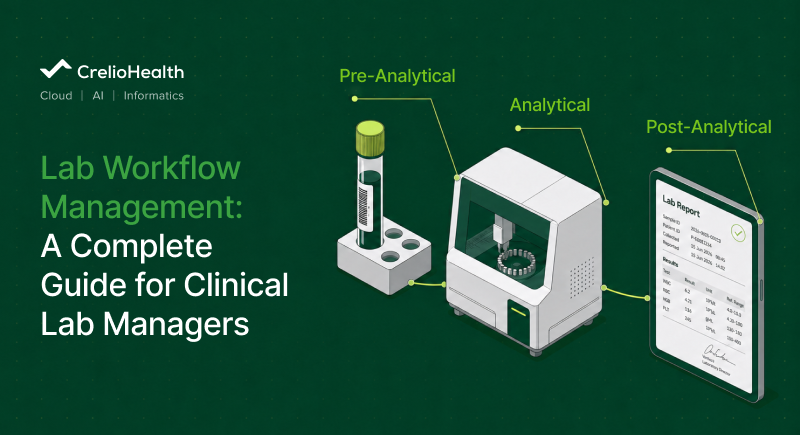
A workflow is the path a sample or task follows through the lab from registration to collection, testing, and reporting. It’s a discipline, not a diagram, that’s divided into pre-analytical, analytical, and post-analytical phases, with every handoff in between.
Workflow management is what you do with that path once it exists: monitoring it, measuring where it slows or breaks down, and deliberately adjusting it, optimizing it, over time; before a bottleneck turns into a backlog.
A lab that documented its workflow once, years ago, and never revisited it is running on a workflow. A lab that reviews TAT trends every month and adjusts staffing and auto-validation rules accordingly is running on workflow management. Same starting point, very different outcomes.
Labs that treat the two as the same thing tend to draw a flowchart once, hang it in the break room, and consider the job done. However, with new instruments added, new modality setups, staff turnover, and test menus expanded, the workflow keeps changing. The documented process quietly stops matching reality.
Who Actually Owns It in Most Labs
Ownership tends to land with the lab director, the quality manager, or the LIS/LIMS administrator, sometimes all three at once, in overlapping ways. That ambiguity is itself a common failure point. Workflow problems without a clear owner get raised at every meeting and fixed at none of them. If you can’t name who’s responsible for your lab’s workflow right now, that’s worth settling before anything else on this page.
Why This Matters More Than It Used To
Four forces are pushing workflow management from a nice-to-have into a core competency. Test volumes are climbing faster than headcount. Staffing shortages in phlebotomy and med tech roles aren’t easing up. Multi-site expansion turns workflows that used to live in one person’s head into genuine compliance risks. And regulatory pressure, from CAP, CLIA, and ISO 15189, increasingly expects documented, monitored processes rather than institutional memory passed between shifts.
The 3 Phases of Every Lab Workflow
Every lab workflow, no matter the lab type, moves through three phases: pre-analytical (sample collection and prep), analytical (testing), and post-analytical (reporting and follow-up). Here’s the part worth remembering: most failures don’t show up in the phase where they’re noticed. They start one phase earlier.
These three phases describe the physical and informational journey of a specimen through your LIMS.
| Phase | What Happens | Common Failure Points |
| Pre-Analytical | Patient registration, sample collection, labeling, and transport | Mislabeling, transport delays, incomplete orders |
| Analytical | Testing, instrument processing, QC checks | Equipment downtime, calibration drift, reagent issues |
| Post-Analytical | Results validation, reporting, dispatch, archival | Reporting delays, transcription errors, unclear formats |
Pre-Analytical: Where Most Errors Actually Start
This phase spans everything before the sample reaches the bench. It’s where the majority of preventable errors originate. Patient misidentification, incomplete test orders, specimen mislabeling, order-sample mismatches, specimen handling & preparation issues, and transport delays account for the largest share of quality errors before testing even starts.
Analytical Phase: The Phase With the Tightest Controls
Testing, instrument processing, and QC checks happen here. Failures in this phase tend to be more mechanical and detectable, mostly because it’s what regulators inspect most closely. Equipment downtime, calibration drift, and reagent lot issues usually get the most monitoring attention. This is why analytical errors are caught regularly and quickly, even though they aren’t where most errors start.
Post-Analytical Phase: The Phase Nobody Watches Closely Enough
Result validation, reporting, dispatch, and archival happen here, and it’s often the most under-monitored stretch of the whole workflow. However, a result can be technically correct and still arrive too late, or correctly generated but formatted in a way that the referring physician has to call and ask about, or land with the wrong recipient. None of that shows up on a standard QC report.
Mapping all three phases explicitly, instead of treating “workflow” as one undifferentiated blur, is where every real optimization effort should start.
How to Optimize Your Lab Workflow: Core Strategies
Optimizing a lab workflow starts with five strategies. None of them will surprise you; every lab manager has heard all five before. What separates labs that improve their TAT from labs that stay flat year after year is sequencing and follow-through, not some undiscovered trick.
1. Standardize Procedures and Protocols
Standardization reduces the variability that turns an occasional error into a recurring one. When three technologists run the same test in three different ways, even within a compliant range, the workflow becomes unpredictable to manage and hard to troubleshoot when something goes wrong.
2. Identify and Fix Bottlenecks
Some bottlenecks are short-term, like when an analyzer is down for maintenance. Others are structural, like a single point of manual data entry that every sample has to pass through, no matter how busy the day gets. Treating both the same way wastes effort. Fix the structural ones first; they’re the ones quietly capping your throughput every single day.
3. Optimize Sample Handling
Specimen labeling, sample handling, transport protocols, and preparation steps close the gap where most pre-analytical errors originate. Small changes here tend to pay outsized dividends. Barcode-first labeling and standardized transport windows are good approaches to improving TAT.
4. Improve Cross-Team Communication
Most workflow delays live in the handoffs between phlebotomy, the bench, and reporting, and between the lab and the referring clinician. Clear handoff protocols close more gaps than new software does.
5. Invest in Staff Training
It’s the highest-leverage long-term fix, and it’s usually the first thing cut when budgets tighten. This is because untrained staff can be the reason standardized procedures and clear handoffs don’t hold in practice.
For a full step-by-step guide to streamlining your laboratory workflow, see our complete optimization guide.
Lab Workflow Technology: LIS, LIMS & Automation
Modern lab workflow management runs on three technology layers working together: an LIS for specimen tracking, a LIMS for data and process management, and automation that removes manual steps between them.
These three layers are often sold and evaluated separately, which leads labs to underinvest in whichever one they last bought. In an optimized workflow, they function as a single system, not three separate purchases.
LIS: Specimen Tracking and Chain of Custody
Your LIS tracks where a sample is, monitors its chain of custody, and its complete lifecycle from accession to disposal. It’s the layer most closely tied to sample identity and traceability, which is exactly why auditors look at it first.
LIMS: Data, Compliance, and Process Configuration
LIS answers where the sample is, whereas LIMS manages the sample-led data. This data is the result produced by test menus, reference ranges, auto-validation rules, reporting formats, and the audit trail.
Automation: Removing the Manual Steps That Cause Errors
Automation reduces the manual steps in between processes. Instrument interfacing eliminates manual result transcription, barcode scanning removes labeling errors at the source, and auto-result entry cuts out one of the largest sources of post-analytical delay: a technologist retyping numbers a machine has already generated.
Cloud-Based Systems: The Layer That Ties It All Together
Cloud infrastructure adds a fourth dimension across all three layers. Remote access for pathologists, multi-site visibility from a single dashboard, and the ability to scale a workflow to a new location without re-architecting it.
The mistake most labs make is treating LIS, LIMS, and automation as three separate buying decisions rather than a single connected stack. These enforce separate ROI cases.
- A LIMS without analyzer interfacing still requires manual transcription.
- Automation without a LIMS to enforce QC gates just moves errors faster instead of removing them.
- A cloud LIMS without automation still leaves a technologist typing results by hand at the exact step automation was supposed to remove.
Lab workflow only improves when all three layers are configured to work together, not evaluated as standalone line items. Hence, technology purchase decisions in this category should be made by whoever owns workflow performance, not by whoever owns the procurement budget alone.
Monitoring and Measuring Lab Workflow Performance
Monitoring workflow performance means tracking turnaround time, error rates, and resource use in real time, not just clearing today’s backlog and calling it done.
Turnaround Time as Your Primary KPI
A single day’s TAT number tells you almost nothing on its own. Historical TAT, trended by test, by shift, by ordering department, reveals what the daily snapshot hides: which shift consistently runs behind, which test consistently exceeds its expected turnaround, and which day of the week the workflow reliably breaks down. That pattern is where the actual fix lives.
Sample Re-Runs and Rejections as Early Warnings
A rising re-run rate for a specific analyzer or collection site is usually an early warning of a workflow problem, not an equipment problem, long before it shows up as a TAT failure.
Inventory Monitoring as Workflow Visibility
Inventory monitoring is workflow visibility, not a separate function. A reagent stockout mid-run is a workflow failure with an inventory root cause, and labs that manage the two separately usually discover that too late.
Dashboards and Real-Time vs. Retrospective Reporting
A lab that discovers its molecular TAT slipped from 18 to 26 hours at month-end has already disappointed every physician from that period. A lab watching TAT trends daily can step in at hour six of the drift, not day thirty. That gap is usually the difference between a real monitoring program and a report nobody reads until the accreditation audit forces the issue. A performance dashboard that shows real-time analytics to review the three metrics is crucial.
For a full breakdown of how to monitor laboratory operations and TAT, see our dedicated guide
Common Lab Workflow Problems (and How to Fix Them)
Most lab workflow problems fall into five categories, and most lab managers can name all five without prompting. The hard part is fixing them before the next accreditation cycle, not scrambling during it.
These five rarely show up alone. A sample tracking error often traces back to a bottleneck that pushed a rushed technologist to skip a labeling step, and a data gap often only surfaces when an audit asks for documentation nobody thought to keep.
Equipment Management
Equipment management problems like irregular maintenance schedules and calibration drift that go unnoticed between scheduled checks surface as analytical-phase failures but usually originate in a maintenance workflow nobody clearly owns.
Process Bottlenecks
These concentrate around manual data entry points and equipment scheduling conflicts, especially in labs running a mix of manual and automated steps, where the automated part moves fast, and the manual part becomes the new ceiling on throughput.
Sample Tracking Errors
Sample tracking errors from mislabeling and cross-contamination risks are pre-analytical failures that are cheap to prevent and expensive to correct once a sample has already moved downstream.
Data Management Gaps
Manual entry errors are a visible problem. Audit trail gaps, missing documentation of who changed a result and why, are the most dangerous ones, and that’s exactly what a CAP or ISO 15189 inspector will look for first.
Regulatory Compliance Pressure
This isn’t a single problem to solve once; it is a moving target. CLIA and ISO 15189 requirements evolve, and a workflow documented as compliant two years ago might not be compliant today without someone actively tracking what’s changed. Labs that treat compliance documentation as a living part of the workflow, updated as the process changes, not reconstructed the week before an inspection, are the ones that walk into an audit calmly rather than scrambling.
See our complete guide to common lab problems and proven solutions for how labs are fixing each of these.
Lab Workflow by Setting: Hospital, Molecular, and Multi-Site Labs
Lab workflow management looks different depending on the setting. Hospital core labs prioritize speed and EHR integration, molecular labs prioritize protocol complexity and data volume, and multi-site networks prioritize standardization across locations.
| Setting | Primary Workflow Priority | See Full Guide |
| Hospital Core Lab | Speed, EHR integration, multi-department coordination | Hospital Lab Workflow Guide |
| Molecular Diagnostics Lab | Protocol complexity, data volume, compliance | Molecular Lab Workflow Guide |
| Multi-Site / Lab Network | Standardization across locations and centralized control | Multi-Site Lab Playbook |
| By Department (Pathology, etc.) | Department-specific routing and reporting | Lab Workflow Examples by Lab Type |
Hospital Core Labs: Speed and EHR Integration
The hospital’s core labs operate under the tightest time pressures in the industry. Emergency department and ICU orders share a queue with routine outpatient work here, so speed and EHR/HL7 integration matter more than almost anywhere else. A delayed critical value doesn’t just miss a TAT target; it delays a clinical decision. A hospital lab running six departments through one queue without department-level routing rules will see an aggregate TAT that looks fine while critical care TAT quietly slips underneath it.
Molecular Diagnostics Labs: Protocol Complexity and Data Volume
Molecular diagnostics labs run a different workflow entirely. Test protocols are longer, more procedurally sensitive, and produce an order of magnitude more data per sample than routine chemistry. Their priority is protocol fidelity and compliance documentation, not raw speed.
Multi-Site Networks: Standardization Without Uniformity
Multi-site lab networks face a problem that neither of the above deals with, which is keeping workflow standardized across locations that don’t share staff, equipment, or sometimes even a LIMS instance. Their priority is centralized control, one workflow definition enforced consistently, not five site-specific versions that drift apart within a year.
By Department: Pathology, Hematology, and Beyond
Routing and reporting requirements shift by department in ways that don’t map cleanly onto one generic template. A pathology workflow and the hematology workflow share the same three phases but rarely the same handoffs.
None of these settings require an entirely separate workflow philosophy. The three phases and the core optimization strategies covered earlier still apply everywhere. What changes is which phase carries the most risk, which metric matters most on a given shift, and how much local variation your lab can tolerate before it turns from a convenience into a compliance liability.
Visualizing Your Lab Workflow
Visualizing your lab workflow through flowcharts, swimlane diagrams, or LIMS-specific maps is the fastest way to spot inefficiencies that are invisible in day-to-day operations.
Why Visual Mapping Catches What Documents Miss
A process document describes what should happen in sequence. A visual map shows where that sequence branches, loops back, or quietly depends on someone remembering an exception rule nobody wrote down.
Flowcharts vs. Swimlane Diagrams vs. LIMS-Specific Maps
Lab flowcharts and swimlane diagrams are separate responsibilities by role or department. Each answers a different question. A flowchart shows the sequence. A swimlane diagram shows who’s responsible for each step, useful for spotting handoffs with no clear owner. A LIMS-specific workflow maps each answer to a slightly different question: what happens, who does it, and how does the system enforce it.
When to Create or Update a Diagram
The right moment is before implementing a new LIS or LIMS, during a workflow redesign, and ahead of any accreditation audit, not after a problem has already surfaced.
Lab Workflow and Data Integration
Lab workflow management and data integration are inseparable. When patient records, instrument data, and reporting systems are disconnected, even a well-designed workflow breaks down at the handoff points.
Why Data Silos Undermine Even Good Workflows
A workflow can be designed perfectly on paper and still fail in practice if the systems executing each step don’t talk to each other. Someone has to move that information by hand, and manual re-entry is exactly where documented workflows quietly diverge from what’s happening on the floor.
EHR/EMR Integration as a Continuity Requirement
A report that generates correctly in LIMS but requires manual entry into the hospital’s EHR has simply moved the post-analytical bottleneck one step downstream instead of removing it.
How Integration Supports Both Speed and Compliance
Integrated data systems support both goals a workflow is supposed to serve at once: Speed, because information moves without manual re-entry. Compliance, because every step in the chain gets captured automatically instead of being reconstructed after the fact when someone asks for proof.
See our complete guide to integrated laboratory data management systems.
Frequently Asked Questions
What is lab workflow management?
Lab workflow management is the practice of designing, monitoring, and continuously improving the flow of samples, data, and tasks through a laboratory, from patient registration to final report delivery. It combines people, processes, and technology to move samples and data through the lab accurately and on time.
What are the 3 phases of a lab workflow?
Every lab workflow moves through three phases: pre-analytical (patient registration, sample collection, labeling, and transport), analytical (testing, instrument processing, and QC checks), and post-analytical (result validation, reporting, dispatch, and archival).
How do you improve lab workflow efficiency?
Improving lab workflow efficiency starts with five strategies: standardizing procedures, fixing bottlenecks, optimizing sample handling, improving cross-team communication, and investing in staff training. Training is the highest-leverage long-term fix, though it’s often deprioritized under volume pressure.
What technology supports lab workflow management?
Three technology layers support lab workflow management: an LIS for specimen tracking and chain of custody, a LIMS for data management and compliance, and automation tools like barcode scanning and instrument interfacing that remove manual steps between them.
How is the hospital lab workflow different from the molecular lab workflow?
Hospital core labs prioritize speed and EHR integration across departments to support emergency and inpatient care. Molecular diagnostics labs prioritize protocol complexity, higher data volume per sample, and specialized compliance documentation over raw turnaround speed.
What’s the difference between a lab workflow and lab workflow management?
A lab workflow is the path a sample and its data take through the laboratory. Lab workflow management is the active, ongoing discipline of monitoring, measuring, and improving that process, rather than documenting it once and assuming it stays accurate.
Conclusion
Effective lab workflow management blends three things: process discipline, the right technology, and continuous monitoring. Labs that treat it as a one-time documentation exercise fall behind the ones that treat it as an ongoing practice, even when both started from the same process map five years ago.
Three takeaways matter more than the rest. Every workflow has three phases, and mapping them explicitly comes before optimizing them, since most failures start a phase earlier than where they’re noticed. Technology – your LIS, LIMS, and automation only help when the process underneath it is sound; automating a broken handoff just makes the failure happen faster. And workflow needs differ by setting: a hospital core lab, a molecular diagnostics lab, and a multi-site network each need a tailored approach, not one generic template stretched to fit.
This guide is the map. The thirteen pages below go deep into each phase, strategy, technology layer, and setting covered here, so start with whichever one matches the problem your lab is living with right now.

