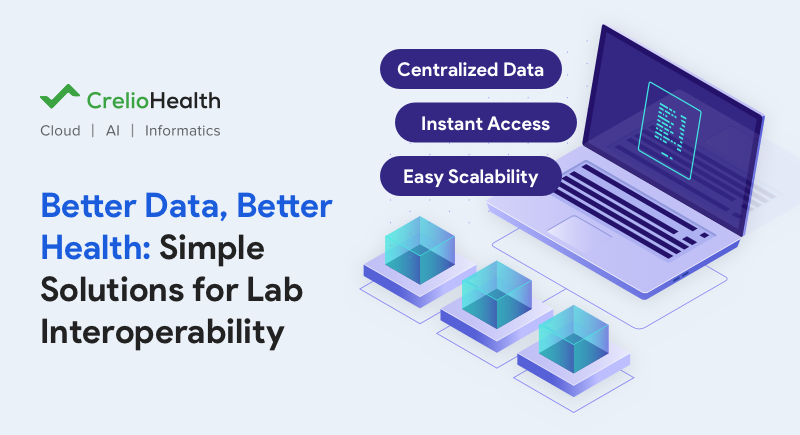


The promise of modern healthcare rests on one fundamental truth: diagnostic speed saves lives. Yet data silos in healthcare quietly undermine this promise every day, as clinical laboratories worldwide operate as isolated data islands, trapped between disconnected instruments, fragmented EHR/EMRs, and provider systems that have no idea what’s happening on the laboratory bench. This “data silo” problem is not a technology inconvenience; it’s a patient safety issue. It drives transcription errors, delays critical diagnoses, and burns out your staff while clinicians grow frustrated waiting for results that should be instant. The cost is measured in both lives and operational dollars. In this blog, we explore the one-stop solution to data silos in healthcare that transforms labs from bottlenecks into clinical powerhouses through lab interoperability.
Table of Contents :
1) The Cost of Disconnection: Errors, Delays, and Stress
2) Simple Solutions for Seamless Connectivity: The CrelioHealth Ecosystem
3) The Outcome: Better Data, Better Operational Health
4) Conclusion
1. The Cost of Disconnection: Errors, Delays, and Stress
Healthcare data silos problems create friction at every disconnect between a clinical lab and the healthcare system, affecting technologists, clinicians, and ultimately patients.
I. Transcription Errors: A Hidden Threat to Safety
Manual data entry in labs is a widespread but critical risk. Each time a result is typed from an analyzer into a LIMS, then into an EMR, the chance for error doubles. Mistakes such as misplaced decimals or incorrect patient IDs can endanger patient care.
Studies show manual transcription error rates between 3–4%, with some errors significantly altering clinical decisions. Compliance audits reveal up to 10.5% of source lab data is lost due to inconsistent or incomplete entry.
These errors lead to duplicate tests, unnecessary interventions, or missed diagnoses. No amount of staff vigilance eliminates human error under pressure. Therefore, process automation to remove manual entry is essential to patient safety.
II. Delays in Lab Reporting Harm Care
Imagine an emergency patient’s tests are completed by 10:45 AM, but due to manual report delivery by email or fax, the physician only sees results at 2:30 PM—five hours later. Such delays extend emergency department stays by 61% and postpone treatments by 43%, per research data.
Without real-time lab status visibility, clinicians spend valuable time chasing results, diverting focus from patient care. Life-threatening conditions like sepsis or a heart attack cannot tolerate such delays. Additionally, when results seem lost, clinicians often reorder tests, consuming resources and putting patients through unnecessary procedures. Fundamentally, these are healthcare data silos problems that show up as clinical friction rather than an IT ticket.
III. Operational Inefficiencies Hurt Productivity
Data silos turn skilled technologists into data clerks. When front desk and instrument data aren’t automatically transferred, administrative staff and medical technologists spend hours reconciling systems instead of analyzing results. This hidden workload distracts from quality and increases burnout. Lack of integrated data also blinds lab leaders to actual test turnaround times and bottlenecks, turning improvement into guesswork. Modern lab connectivity solutions surface these healthcare data silos problems in real time so leaders can act before the backlog compounds.
Consider a 50-person lab spending just one hour daily on disconnect management, that’s 2,600 hours annually wasted, costing hundreds of thousands in labor and lost productivity.
2. Simple Solutions for Seamless Connectivity: The CrelioHealth Ecosystem
Modern clinical labs need a fundamentally different approach to data silos in healthcare. Rather than building workarounds on top of legacy systems, they need laboratory interoperability platforms engineered from the ground up for scalable lab interoperability. CrelioHealth solves healthcare data silos by treating connectivity not as an add-on but as the core foundation of the entire platform, delivering hospital lab connectivity solutions ready to expand lab reach with interoperability across every partner and site.
I. The EMR/EHR Handshake: Mastering Clinical Integration
Hospitals rely on major EMR platforms like Epic, Cerner, and Oracle Health, yet many labs struggle with legacy LIMS that cannot natively communicate. CrelioHealth eliminates this gap with certified HL7 and FHIR support, delivering the kind of lab interoperability that turns fragile point-to-point interfaces into standards-based hospital lab connectivity solutions ready for scale:
- Native HL7 and FHIR Support: CrelioHealth speaks every major EMR’s language with certified, bi-directional standards, enabling instant and secure order reception from providers.
- Real-Time Results Delivery: Validated results are instantly transmitted back to EMRs, accelerating clinical decisions without manual intervention or phone calls.
- Seamless Billing Data Flow: Automated charge capture and coding integration improve billing accuracy and accelerate revenue cycles, freeing your IT team from complex interface management.
CrelioHealth Advantage: Your lab IT team is freed from the burden of managing complex, custom integrations. Instead of spending months coding and testing custom HL7 interfaces, CrelioHealth’s certified connections to Epic, Cerner, and other major EMRs are pre-built, tested, and ready to deploy. This means faster go-live, lower IT costs, and confidence that data is flowing correctly.
II. Instrument Data Centralization: Connecting Every Analyzer
Disconnected analyzers are a leading cause of healthcare data silos and daily bench-side data chaos. CrelioHealth integrates natively with major instrument platforms, delivering scalable lab interoperability at the analyzer layer and ensuring:
- Automatic Result Capture: Every analyzer sends results directly to CrelioHealth, eliminating manual entry and transcription errors.
- Complete Audit Trails: Each result includes detailed provenance for compliance, documenting user, instrument, reagent batch, and verification timestamps.
- Middleware Data Harmonization: Diverse and legacy instruments integrate smoothly into one consistent, reliable data stream for technologists.
CrelioHealth Advantage: Manual transcription errors drop to near-zero. Technologists who used to spend 30% of their day re-entering data now spend that time on higher-value work: quality review, troubleshooting, and method optimization. This productivity gain alone often justifies platform investment within months.
III. Instant Access via Digital Portals: Provider and Patient Empowerment
Results are only valuable when they reach the right person at the right time. With interconnected systems, results appear instantly in the secure physician portal upon verification—no delays or batching. Patients also get immediate, secure access to their own test results, often before contacting the lab.
- Secure Physician Portal: Providers get instant, full-context access to lab results—including alerts for critical values—reducing turnaround time significantly.
- Patient Portal Transparency: Patients access their test results securely and promptly, lowering call volumes and improving engagement with health data.
- Context-Rich Reports: Portals display reference ranges, units, prior results, and interpretive comments to support informed clinical decisions.
CrelioHealth Advantage: Our secure provider and patient portals deliver verified results instantly to physicians and patients, eliminating delays and batch reporting. This reduces turnaround times by up to 80%, ensuring critical alerts are timely, and significantly lowers lab call volumes by enabling patients to self-serve result access. Combined with the underlying hospital lab connectivity solutions, this is what lab interoperability looks like from the physician’s screen.
IV. The Cloud API Backbone: Designed for Future Growth
CrelioHealth is cloud-native from the ground up, with robust REST-based APIs that make LIMS integrations fast, reliable, and inexpensive. This is the shape modern laboratory interoperability platforms have to take to expand lab reach with interoperability without stalling on legacy IT.
- Cloud-Native Architecture: CrelioHealth’s platform is built on modern cloud infrastructure with RESTful APIs for fast, reliable, and secure integrations.
- Rapid Connectivity: Easily connect to reference labs, billing systems, AI tools, and new hospital systems without the delays of legacy upgrades.
- Future-Proof Platform: Designed to scale and adapt as healthcare evolves—embracing AI diagnostics, genomics, and precision medicine while maintaining compliance and security.
CrelioHealth Advantage: You avoid the painful, expensive legacy system upgrades that have derailed countless labs. Instead, you have a modern, extensible platform that integrates cleanly with whatever new tools and partners your lab needs to adopt. Practical healthcare data silos solutions look exactly like this: modern lab connectivity solutions that grow with the lab, not against it.
3. The Outcome: Better Data, Better Operational Health
When data silos in healthcare are eliminated, the transformation is immediate and measurable. Labs don’t just run more efficiently, they fundamentally change how they contribute to patient care. The quantifiable benefits of seamless lab interoperability are:
I. Financial Health
Maximizing laboratory financial performance begins with streamlining operations and minimizing costs. Closing data silos in healthcare removes the hidden tax on labor, and healthcare data silos solutions consistently pay for themselves within the first year through cleaner billing, fewer retests, and faster claim cycles.
- Labor costs shrink as manual data entry, reconciliation, and troubleshooting are eliminated, allowing existing staff to manage higher test volumes efficiently.
- Error-related expenses disappear with fewer transcription mistakes, leading to reduced retests, liability risks, and audit burdens.
- Revenue cycles accelerate through automated, accurate billing, enabling faster claim submissions, fewer denials, and improved cash flow that can recover substantial annual revenue.
- System maintenance becomes more predictable and less disruptive with modern, cloud-based platforms, requiring less custom upkeep than traditional on-premises systems.
II. Clinical Quality
Delivering reliable, timely, and actionable lab results is critical to patient outcomes and provider trust. Data silos in healthcare directly work against that, while healthcare data silos and disconnected reporting steal minutes off every critical result. True lab interoperability restores the accuracy and turnaround discipline that clinical teams depend on.
- Data accuracy improves significantly when results are transmitted directly from analyzers to LIMS and then to EMR, reducing human transcription errors.
- Faster turnaround times (TAT) give labs a competitive edge, increasing provider confidence and patient satisfaction through near-instant results.
- Automated critical value alerts ensure urgent findings reach providers immediately, facilitating quicker diagnoses and life-saving interventions.
- Complete and accurate lab data empowers physicians to make swift, well-informed treatment decisions that improve patient care.
III. Scalability and Growth
Sustainable lab growth depends on flexible, scalable technology that supports expanding services, locations, and regulatory demands without bottlenecks. This is where modern laboratory interoperability platforms earn their keep: they let labs expand lab reach with interoperability into new sites, specialties, and CRO partnerships without a fresh integration project each time.
- Scaling up capacity, whether adding analyzers, opening new sites, or integrating acquisitions, is seamless with CrelioHealth’s adaptable connectivity framework.
- Business expansion opportunities for labs flourish as IT hurdles diminish, enabling new service offerings, partnerships, and revenue sources.
- Compliance adapts smoothly to evolving regulations, ensuring that HIPAA, CLIA, OSHA, and other standards are met through configurable platform features rather than costly custom development.
Conclusion
The era of isolated clinical laboratories is over. Modern labs demand real-time, accurate, interoperable data flowing seamlessly between instruments, providers, and patients. Labs that continue operating as data islands aren’t just inefficient; they’re delivering suboptimal care to their patients. CrelioHealth LIMS is purpose-built to eliminate data silos in healthcare and transform clinical labs into integrated engines of diagnostic excellence. By choosing scalable lab interoperability and modern lab connectivity solutions, labs address healthcare data silos problems at the root and reclaim their place as essential partners in clinical care. Healthcare data silos solutions of this kind are what let speed and accuracy save lives at the point of decision.
Frequently Asked Questions
What are the most common failure causes of hospital lab data connectivity solutions?
Most hospital lab data connectivity solutions fail for one of five reasons: expired or misconfigured HL7 and FHIR interface certificates, mismatched code sets between the lab and hospital (LOINC, SNOMED CT, ICD-10), heavily customized point-to-point interfaces that break with every EMR upgrade, network segmentation rules that quietly block traffic on non-standard ports, and vendor gaps where the LIMS never received a certified interface for a specific EMR release. Auditing these five areas quarterly catches most connectivity failures before they impact patient results.
How should labs handle DICOM data silos in hospitals where imaging and lab systems do not talk?
DICOM data silos in hospitals exist because DICOM (used for medical imaging) and HL7 (used for lab and clinical messaging) evolved as separate standards, so a lab result and a radiology image about the same patient often live in disconnected archives. The standard fix is to route both feeds into a vendor-neutral archive (VNA) and use the enterprise patient master index to cross-link records, so a clinician viewing a chest CT can see the paired D-dimer or troponin without switching systems. For a lab specifically, this means your LIMS should expose clean HL7 or FHIR exports that a VNA can consume alongside DICOM feeds from radiology.
What ROI can hospital administrators expect from integrating multiple departments into one platform?
Typical payback on a multi-department integration project runs 12 to 24 months once labor savings, faster billing cycles, and error-related cost avoidance are added together. The single largest line item for most administrators is revenue cycle acceleration, since claims submitted with clean structured data from an integrated platform tend to get paid two to three weeks faster than claims from siloed systems, with lower denial rates and less rebill labor. Departmental instant silo integration also compounds over time, as onboarding a new site or specialty later takes days rather than months.
What separates scalable lab interoperability from basic point-to-point integration?
Point-to-point integration means every system talks directly to every other system, which works for two or three connections but turns into unmaintainable custom code as sites, analyzers, and CRO partners multiply. Scalable lab interoperability uses a hub-and-spoke or API-first pattern where every source and destination connects once to a central platform, so adding a new instrument, a new hospital, or a new partner becomes a configuration change rather than a full integration project. This is the architectural difference between a lab that can double capacity in a year and one that hits a ceiling every time IT is asked to add a connection.
What compliance standards should hospital lab connectivity solutions meet?
In the United States, hospital lab connectivity solutions need to satisfy HIPAA privacy and security rules, HITECH breach notification requirements, and CLIA for the underlying lab operations, with 21 CFR Part 11 relevant for regulated study data and electronic signatures. Internationally, ISO 15189 covers medical lab quality and competence, and hospitals often layer CAP accreditation checklists that specifically call out interface validation and audit trail retention. A production-ready connectivity solution should provide documented evidence for each requirement: encrypted transport, access controls with unique user attribution, immutable audit logs, and validated interface change management.

