

The success of any clinical trial, whether it’s an early-stage safety study or a long-term project, depends heavily on how effectively the laboratory performs under pressure. When labs struggle with bottlenecks, the result isn’t limited to slower workflows. This can ripple across timelines, create unnecessary rework, and jeopardize result consistency. Even a single lapse related to quality control in clinical trials can set back months of progress. Identifying these pressure points early gives laboratories the resilience needed to support fast-moving research environments and maintain reliable outcomes.
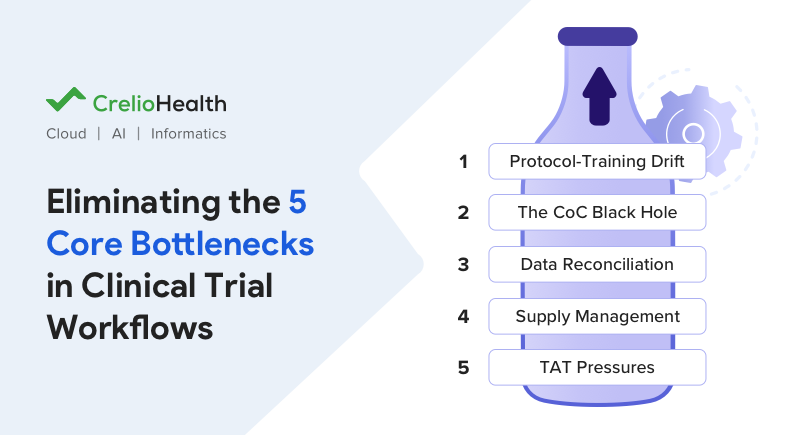
A major operational reality is that labs must constantly balance routine diagnostic work with high-priority clinical trials. However, the non-standardized demands and multiple clinical trial protocols make it tough for lab personnel. This creates gaps, inefficiencies, and workflow breakdowns that quietly hinder performance. Below, we break down five of the most common bottlenecks and practical strategies to overcome them.
Bottleneck 1: Protocol Deployment and Training Drift
I. The Challenge (The Bottleneck):
Every clinical trial comes with its own expectations. This includes unique SOP variations, validation records, and quality metrics. This creates consistency, a major challenge, especially in labs where multiple teams support the same project over different shifts. Any misalignment can influence how teams approach assessing the quality of controlled clinical trials, and even small deviations can escalate into regulatory concerns.
Training decay is one of the biggest risks. As trials run for years, procedural drift becomes almost inevitable when protocols aren’t systematically reinforced or updated.
II. Mitigation Strategy:
Digital SOP Management:
Leverage a centralized system that maps specific assays directly to current trial SOPs and offers updated access whenever a version is updated. This helps staff across different shifts and timelines to adhere to relevant practices without frequent updates or training. This also prevents potential workflow disruption for a given assay.
Mandatory Digital Sign-offs:
A structured digital sign-off process ensures team members validate protocols before running any trial-specific test. This also strengthens clinical trial data integrity by preventing unauthorized or untrained staff from performing critical steps.
Focused Cross-Training:
Instead of re-teaching complete procedures, targeted training modules help staff understand exactly where a trial differs from routine lab operations. This reduces confusion and minimizes procedural drift over time.
Bottleneck 2: The Black Hole of Sample Logistics and Custody
I. The Challenge (The Bottleneck):
The criticality of managing clinical trial specimens across multiple investigator sites leads to many challenges. From packaging errors to temperature deviations, missing paperwork, and more, these issues compromise data integrity in clinical trials. If labs require redraws for any given reason, it causes unwanted delays and additional costs for sponsors. As a result, the struggle, more than the trial procedure, lies in the logistical and custody side of specimen handling.
II. Mitigation Strategy:
Integrated Chain of Custody (CoC) Tracking:
Using 2D barcoding to track every movement gives full transparency from collection to storage and analysis. This tracking technology eliminates loopholes, leakages, and data loss throughout the clinical trial. It also prevents confusion during audits or sponsor reviews.
Automated Receiving Checks:
Utilize a lab automation system that automatically acknowledges and flags specimens when received at the processing facility. The system also uses color codes to flag rejected or ‘redraw’ specimens that indicate temperature or quality issues. Such solutions prevent compromised samples from entering the workflow.
Digital Manifest Reconciliation:
Replace paper manifests with secure, real-time digital manifests that are quick to reconcile. Digital trials minimize errors and eliminate data loss discrepancies. This prevents disruptions of clinical trial data integration when coordinating or communicating with multiple sites.
Bottleneck 3. Data Reconciliation and the eCRF Disconnect
I. The Challenge (The Bottleneck):
Clinical trial results must be accurately and rapidly transferred from the Laboratory Information Management System (LIMS) into the sponsor’s Electronic Case Report Form (eCRF). This transfer often involves manual data entry, multiple software environments, or complex proprietary interfaces that become fragile during mid-trial protocol changes.
Labs are responsible not only for generating results but also for ensuring they are transmitted correctly into sponsor systems. When the LIMS and eCRF environment don’t communicate seamlessly, the process quickly becomes error-prone. Manual entry, mismatched fields, and version changes create delays that can threaten clinical trial data integrity if not handled carefully.
As trials progress, mid-study modifications or additional data points can strain already fragile interfaces.
II. Mitigation Strategy:
Bi-Directional Interface Standardization:
Prioritize the development of standardized, automated data interfaces (e.g., CDISC standards or validated APIs) between the LIMS and the eCRF systems. Standardized, validated data exchange formats, such as CDISC or custom APIs, reduce interface failures and minimize reconciliation errors.
Batch Verification and Audit Trails:
Implement a secondary batch verification step that checks against the source LIMS record before final transmission, leaving an immutable audit trail of the entire transfer process. A structured verification step ensures that every record is compared against its LIMS source, creating a reliable audit trail that supports assessing the quality of controlled clinical trials during sponsor reviews.
System Flags for Critical Values:
Automatically flag results that fall outside the trial’s defined critical range so they are reviewed by a supervisor before release, minimizing later query resolution time. Automatically flagging unexpected results for review helps reduce downstream queries and improves the overall accuracy of clinical trial data integration into sponsor systems.
Bottleneck 4: Clinical Trial Kits and Supply Management
I. The Challenge (The Bottleneck):
Trial protocols often require specialized reagents, consumables, or custom collection kits unique to that study. Mismanagement of this inventory, including expiry of single-use components, stock-outs, or ordering the wrong kit version, leads to immediate trial downtime and financial loss.
II. Mitigation Strategy:
LIMS-Linked Inventory:
Integrate inventory directly into the LIMS module to manage ordering, receiving, and stock movement across different clinical trial projects. A robust inventory management solution prevents under- or overstocking and wastage during trials.
Automated Reorder Triggers:
Establish minimum stock thresholds and automated alerts based on expected enrollment rates and assay volume, ensuring proactive resupply before stock-outs occur.
Batch Expiry Tracking:
Track all high-value, batch-sensitive reagents by lot number and automatically generate warnings well in advance of the expiration date.
Bottleneck 5: Specialized Assay Turnaround Time (TAT) Pressures
I. The Challenge (The Bottleneck):
Complex, low-volume assays, especially in molecular diagnostics or flow cytometry, require highly trained staff and often have long processing times. When these assays pile up due to staff shortages, the resulting TAT failure can severely impact crucial sponsor decision points.
II. Mitigation Strategy:
Workflow Prioritization Engine:
Implement LIMS logic that automatically assigns a high-priority flag to clinical trial samples, dynamically moving them to the front of the queue based on the specific protocol’s mandated TAT.
Capacity Modeling:
Use historical data on assay run times and staff availability to model potential bottlenecks before they occur, allowing managers to adjust resources in advance of heavy sample loads.
Technology Investment:
Assess where new technology (e.g., AI solutions or automated tools) can take over manual, repetitive tasks to free up skilled scientists for complex analytical work, directly improving TAT for specialized tests.
Conclusion
As clinical trials continue to expand in complexity and volume, laboratories are under more pressure than ever to operate at speed, accuracy, and unwavering compliance. Identifying bottlenecks early is no longer optional; it’s fundamental to protecting trial integrity and maintaining sponsor trust.
By focusing on protocol consistency, secure sample handling, streamlined data transfer, robust kit management, and specialized assay capabilities, laboratories can not only meet modern clinical trial expectations but exceed them.

