
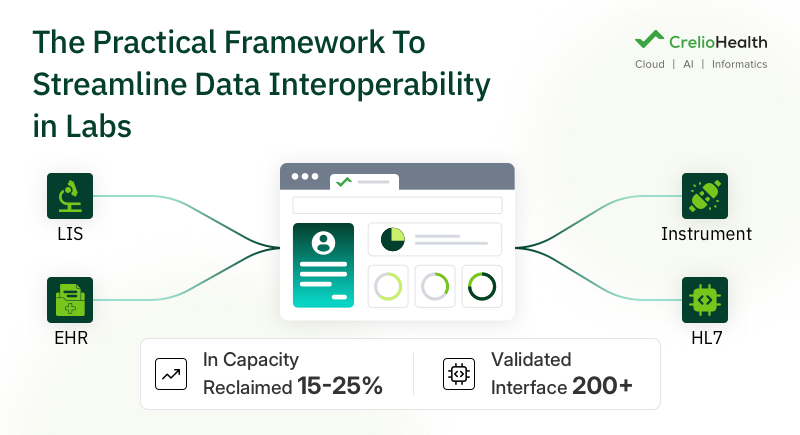

Your lab IT team is not short-staffed. 15–25% of its capacity is being consumed by work that should not exist. Spreadsheet exports, CSV transfers, HL7 batch reconciliations twice-daily, and phone calls untangle mismatched patient IDs. This is the hidden cost of poor lab data interoperability. It’s not a single dramatic failure, but a slow, structural bleed of productive capacity into workarounds that were supposed to be temporary.
This article maps the five most common interoperability failure patterns, quantifies their costs, and helps you gauge where your lab sits today. It outlines the architectural principles and sequencing required to eliminate manual bridge work at the source.
The 5 Most Common Lab Interoperability Failure Patterns
These patterns do not appear in isolation. Most enterprise labs carry at least three of them simultaneously. Which is why fixing one interface while the others remain broken rarely produces the capacity recovery IT teams are looking for.
Pattern 1: HL7 Version Fragmentation
Most enterprise laboratories continue to rely on HL7 v2 interfaces for legacy systems, including LIS, billing platforms, and EMR integrations developed over the past decade, while increasingly facing demands from new EHR partners and affiliated health networks to support HL7 FHIR.
The result is two parallel interface maintenance tracks with incompatible data models. Patient demographic fields map differently. Order identifiers are formatted differently. Result acknowledgment logic behaves differently. When a single patient encounter touches both tracks, identity reconciliation becomes a manual task. There is no single system of record, and your integration team becomes the human middleware holding the two together.
This is the most widespread HL7 lab integration failure pattern in multi-system enterprise environments, and it is becoming more common as FHIR adoption accelerates across the EHR ecosystem.
Pattern 2: Instrument Interface Gaps
Not every analyzer on your lab floor has an active, validated, bidirectional interface to the LIS. Instruments acquired after the original LIS implementation, specialty instruments from vendors without established LIS partnerships, and instruments inherited from lab acquisitions frequently become manual result entry islands.
Each of these islands is a transcription error risk, a WHO-documented source of diagnostic discrepancy, and a TAT delay. One instrument without an active interface adds an average of 15–45 minutes of manual handling per run to the workflow. Across a high-volume hematology or chemistry lab, where compounds are quickly.
Pattern 3: Reference Lab Data Silos
Send-out test results arrive through three channels: an HL7 feed, a reference lab portal that requires manual login and export, and, in many labs, still a fax. These three data streams must be reconciled manually into the patient record in the LIS before the result can be verified and reported.
The reference lab result that arrives by fax and gets hand-keyed into the LIS is just inefficient. This is a patient safety risk. A 2019 analysis in the Journal of the American Medical Informatics Association identified manual data transcription as a persistent contributor to laboratory reporting errors: errors that, in time-sensitive clinical situations, delay critical decisions.
Pattern 4: EHR Order-to-Result Fragmentation
Electronic physician order entry should generate a complete, structured order in the LIS with all required clinical context, ICD-10 diagnosis codes, relevant clinical notes, and reflex testing criteria. In practice, labs frequently receive incomplete orders: missing diagnosis codes, absent clinical notes required to authorize a send-out, or incorrect specimen type specifications.
This is a lab interoperability failure at the point of order, not the point of result. The downstream cost is manual order reconciliation, phone calls to ordering physicians, order holds, and specimen recollection. CLSI GP29-A3, the guideline governing laboratory requisitions and test ordering, explicitly addresses the information requirements for complete electronic orders. Many EHR-LIS integrations fail this standard silently.
Pattern 5: Patient Identity Mismatch (MPI Problems)
LIS uses the MRN. The billing system uses the insurance member ID. The patient portal uses a self-registered email and date of birth. The reference lab uses the date of birth and name. Without a Master Patient Index strategy that assigns a single, resolvable identifier shared across all connected systems, the same patient exists as multiple identities, creating merge conflicts, resulting in routing errors, and a fragmented clinical history that no single system can see in full.
According to a 2020 report from the American Health Information Management Association (AHIMA), patient matching errors affect up to 20% of records within individual hospital systems and up to 50% when matching across organizations. In laboratory workflows, this translates directly to result misrouting and patient safety exposure.
How to Know If Your Lab Has a Serious Interoperability Problem
Before moving to costs and solutions, it is worth conducting a direct self-assessment. Labs often underestimate the severity of their interoperability debt because the workarounds have already normalized into daily operations. Answer these three questions honestly.
- How many of the five patterns above exist in your current environment? If the answer is three or more, your lab is almost certainly carrying the full-time equivalent of manual bridge overhead, whether or not it shows up as a line item in your budget.
- When a new EHR partner, collection center, or reference lab relationship requires a new interface, how long does it take from agreement to go-live? If the answer is longer than 60 days for a standard HL7 connection, your integration capacity is already constrained by maintenance debt on existing workarounds.
- When was the last time your interface validation logs were reviewed ahead of a CAP or CLIA inspection, not reactively, but as standard practice? If the answer is “during the last inspection,” your audit trail posture is reactive, not managed.
If any one of these questions surfaces a gap, the cost section below will put a number on what that gap is worth.
What the Manual Workaround Culture Actually Costs
The deeper problem with manual bridges is not any single event; it is that labs stop seeing them as costs at all. The spreadsheet export has become part of the morning routine. Fax transcription becomes someone’s job description. The cost becomes invisible precisely because it has been normalized.
Direct Cost
Each manual bridge, each CSV export, each fax transcription, each phone-call reconciliation carries three embedded costs that labs rarely track in aggregate.
- Staff time: Manual data transfer events range from 15 minutes (a simple portal export) to 60+ minutes (a multi-system identity reconciliation). In a lab handling 500 send-out tests per month with a 30% fax- or portal-based return rate, that is 75–150 staff hours per month spent on transcription alone.
- Transcription error risk: Every manual data entry step carries an error probability. Laboratory science literature consistently reports manual transcription error rates of 0.1–1.0% per entry. At high volumes, that probability materializes into real events: mislabeled results, incorrect patient associations, and missed critical values.
- Audit trail gaps: Manual data transfers outside the LIMS leave no auditable record of who transferred what, when, and whether the data matched the source. For CAP- and CLIA-accredited labs, this is an active risk of inspection findings. CAP checklist item GEN.20360 specifically requires that LIS interfaces be validated and that the integrity of data transfers be documented. Labs that rely on manual bridges for reference lab results or instrument data are carrying a compliance exposure that does not require a major error to surface; it surfaces at the next inspection.
The Compound Cost
When lab IT capacity is consumed by managing existing workarounds, strategic work does not happen. New EHR connections that would expand physician referral reach get deprioritized. New collection center onboarding takes months instead of weeks. The analyzer interface builds a queue behind maintenance. The labs that struggle most with a lack of interoperability are not the ones that started behind. They are the ones that tolerated workarounds long enough to make strategic integration impossible.
The Architectural Approach: Eliminating Manual Bridge Work
The difference between labs that solve interoperability and labs that perpetually manage it comes down to one decision: whether you address integration at the workaround level or at the architecture level. Workaround-based labs solve each problem individually. Architecture-based labs solve it once, at the infrastructure level, and every future connection inherits the solution.
The four principles below are not meant to be implemented simultaneously. They have a sequencing logic, described at the end of this section, that reflects both the dependency structure between them and the operational risk profile of each change.
Principle 1: One Patient Identity, One Record
Implement a consistent Master Patient Index strategy across all integrated systems. Each patient should carry a single, resolvable identifier shared between the LIS, billing system, patient portal, EHR, and reference lab interfaces. This is not a complex technical requirement; it is a governance decision that most labs defer because it requires cross-system agreement. That deferral is what keeps identity reconciliation as a permanent manual task.
An MPI-aligned LIMS integration framework eliminates merge conflicts, resulting in misrouting and historical data fragmentation at the source. It also makes every downstream audit cleaner, with one patient record and one traceable history.
Principle 2: Instrument Interface Completeness
Every analyzer on the lab floor should have a validated, bidirectional interface to the LIS. No manual result entry islands. This is not a luxury feature; it is a baseline requirement for a compliant, efficient lab workflow under CAP GEN.20316 (data entry accuracy) and CLIA quality systems requirements.
The business case is direct. The TAT improvement from eliminating manual result entry for a single high-volume instrument typically recovers the interface build cost within two to three months of operation. Across a five-instrument lab, annual labor cost savings routinely exceed $80,000–$120,000 at large-volume facilities.
Principle 3: Eliminate Batch Processing; Move to Real-Time Event-Driven Integration
Batch HL7 transfers, the twice-daily or hourly scheduled file exchanges that many labs still run, are a legacy architecture pattern with three structural problems: they introduce latency, they create reconciliation complexity when batches partially fail, and they fail silently in ways that are often discovered only when a clinician calls asking where a result is.
Real-time, event-driven FHIR lab integration changes the model. Each order event, each result event, and each demographic update triggers an immediate HL7 or FHIR R4 transaction that is acknowledged, logged, and traceable. There is no batch to reconcile. There is no silent failure window. Labs that remain on batch architectures will face increasing friction as health network partners and EHR vendors retire their legacy interfaces on their own migration timelines.
Principle 4: Native FHIR as the Forward Integration Standard
New integrations should be built on FHIR R4. Legacy integrations should be migrated to FHIR on a defined schedule. This is not a vendor preference; it is the direction the entire EHR and health exchange ecosystem is moving, accelerated by CMS interoperability rules (CMS-9115-F) that mandate FHIR-based API access for patient data exchange.
Labs that build new EHR connections on HL7 v2 today are building integrations they will have to rebuild within five years. Building on FHIR now means those connections remain forward-compatible as the ecosystem continues to migrate.
The Right Sequencing: Where to Start
Architecture decisions land differently depending on where you start. The recommended sequence is:
Step 1: MPI first.
Patient identity is the dependency that everything else sits on. A clean, consistent patient identifier across systems makes instrument interfaces, reference lab connections, and EHR integrations all more reliable from day one. Resolving MPI before building new interfaces means you do not rebuild identity reconciliation logic into every new connection.
Step 2: Instrument interface completeness.
This is the highest-ROI move for most labs and the lowest-disruption change relative to its payoff. Closing the manual result entry islands removes the most operationally visible workarounds and generates measurable TAT and labor savings within the first quarter.
Step 3: Batch to real-time migration.
Once the instrument interfaces are complete and patient identity is resolved, migrating batch HL7 feeds to real-time event-driven transactions has a clean operational foundation. This is where reference lab auto-posting and EHR order-to-result flows become genuinely reliable rather than dependent on daily reconciliation.
Step 4: FHIR migration for new and legacy connections.
This is a multi-quarter effort for most labs and should be planned as a phased transition, not a cutover. New connections go FHIR-native immediately. Legacy v2 interfaces are migrated on a defined schedule, typically prioritized by the volume and clinical criticality of the connection, while the v2 interface remains in parallel operation until the FHIR connection is validated.
How CrelioHealth Solves This Architecturally
Most LIMS vendors treat integration as a feature list: a set of connectors built on request, maintained reactively, and priced as add-ons. CrelioHealth’s integration architecture is built around the four principles above, not as bolt-ons but as the platform foundation.
- The platform supports 200+ active instrument interfaces. It covers major analyzers from Siemens Healthineers, Roche Diagnostics, Abbott Diagnostics, Beckman Coulter, and others. All these are validated, bi-directional communication and no manual result entry requirements on any supported interface.
- For HL7 lab integration and FHIR integration for labs, CrelioHealth supports both HL7 v2 and FHIR R4 natively. For labs mid-contract on legacy LIS systems or managing a transition from v2 to FHIR-native connections, the migration path works in parallel operation. The existing v2 interface runs alongside the new FHIR connection through a defined validation period. Typically, four to eight weeks, depending on transaction volume, before the v2 interface is retired. This eliminates cutover risk and gives the lab’s IT team a verifiable, side-by-side comparison before the switch is final.
- EHR integration operates via industry-standard protocols. Reference lab routing includes auto-result posting directly to the patient record. These eliminate the need for portal logins and fax-transcription workflows.
- The integration architecture is actively monitored by CrelioHealth’s interface engineering team. This means interface downtime and silent failures are detected and resolved proactively, not discovered when a clinician calls about a missing result.
Conclusion: Integration Is Not a Project, It Is a Platform Decision
Labs that solve interoperability by adding manual bridges will continue to add manual bridges. Each workaround creates a dependency. While each dependency creates maintenance overhead, each new system added to the environment inherits the fragmentation of everything that came before it.
Labs that address how to achieve interoperability at the architectural level eliminate the integration tax for every future connection, not just the current one. The payoff is not just operational efficiency. It is the recovery of the IT capacity that has been subsidizing bad architecture for years. And, the compliance posture that comes from having a documented, auditable, validated integration environment rather than a collection of manual transfers that no inspection log can account for.
If your integration roadmap is currently a list of workarounds waiting to be formalized. It is worth examining before the next EHR partnership, collection center expansion, or CAP inspection makes the technical debt materially worse.

