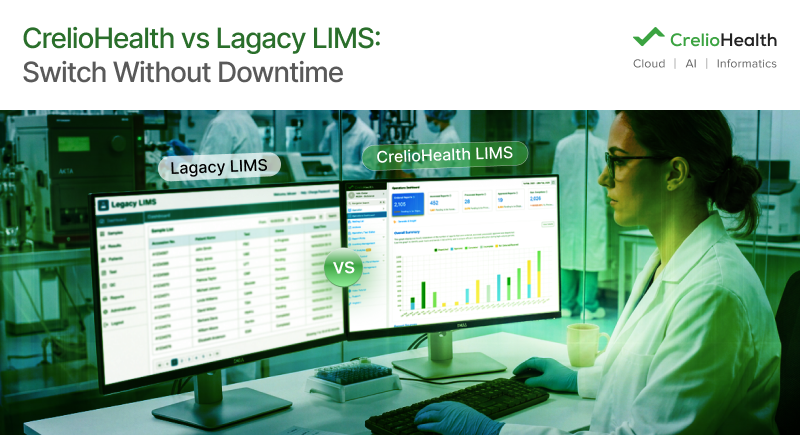

Ask any lab director why they’re still running a legacy LIMS three renewal cycles past its prime, and the answer isn’t inertia. It’s fear, and it’s specific. We’ll lose data in the switch. We’ll eat three days of downtime. We won’t pass our next CAP inspection because the audit trail didn’t survive the migration. Those fears made sense ten years ago, when a LIMS migration meant a weekend blackout and a prayer. They don’t make sense anymore.
CrelioHealth is a cloud-native SaaS LIMS built for U.S. diagnostic labs. It replaces legacy platforms in 60 to 90 days, using a parallel-run model; both systems stay live at once until the data is validated, so production never stops. This is not a sales pitch. There’s a mechanical fact about how the migration is structured, and this guide walks through exactly how.
We’ll cover how CrelioHealth stacks up against the legacy LIMS most U.S. labs are still running, what a 90-day migration looks like week by week, and why the labs that have already made the switch tend to say the same thing: the decision was harder than the transition.
Why the U.S. Diagnostic Labs Are Reaching the Legacy LIMS Breaking Point
Legacy LIMS platforms were built for a different kind of lab. One with an on-site IT team, a tolerance for scheduled downtime, and a single building to worry about. That’s not the lab most directors are running in 2026. Multi-site collection networks, growing analyzer fleets, and referring physicians who expect a same-day report have quietly outgrown what these systems were ever designed to handle. It’s no surprise that so many labs are now actively planning to modernize their lab information systems instead of absorbing yet another upgrade cycle.
Four signs tend to show up first, and most lab managers will recognize at least two of them immediately.
- LIMS upgrades start demanding their own downtime window every 12 to 18 months, like clockwork. A major release means a 72-hour maintenance window, an outside IT contractor on the payroll, and a full revalidation before anyone can log back in.
- The instrument backlog: every new analyzer adds another 4-to-12-week integration project, because legacy platforms build interfaces one at a time and bill for it as professional services.
- Cross-site analytics becomes its own headache, too; labs running more than one collection center usually end up bolting on a separate BI tool, because the core system was never built to show performance across locations in real time.
- Audit prep, which should take an afternoon, eats up two or three full staff days before every CAP or CLIA inspection, because the documentation lives in five different places instead of one.
If either of those sounds familiar, your lab isn’t far behind. It’s simply arrived at the point where a legacy LIMS replacement stops being a someday project and starts being an overdue one.
The hidden cost of staying put
The sticker price of doing nothing looks like zero, but it isn’t. Here’s where the real cost hides:
- Maintenance escalation: Annual contracts typically carry 8–15% CPI clauses. The same system gets more expensive every year without adding a single feature.
- New site provisioning: Each collection center needs its own local IT setup before it can go live.
- Diverted IT headcount: Staff who could modernize lab operations instead spend their time patching and interfacing an aging system.
- Thinning vendor support: As legacy platforms age out of active development, compliance risk rises quietly; not because the lab changed anything, but because the system underneath it did.
For a full breakdown of where legacy LIMS costs accumulate, see our LIMS pricing guide.
CrelioHealth vs Legacy LIMS: Side-by-Side Comparison
CrelioHealth is a cloud-native SaaS LIMS built for US diagnostic labs. Here’s how it compares to the legacy enterprise platforms most labs are running today.
| Dimension | ✅ CrelioHealth | ⚠️ Legacy Enterprise LIMS |
|---|---|---|
| Architecture | Cloud-native SaaS; no local infrastructure | Server-based or lift-and-shift hosted; heavy IT dependency |
| Implementation timeline | 60–90 days: standardized playbook | 6–18 months, custom-heavy |
| Instrument integration | Library of 500+ certified bi-directional interfaces | Custom-built per analyzer; 4–12 weeks per interface |
| Upgrade policy | Automatic cloud updates; no lab IT involvement | Scheduled major releases; revalidation required each cycle |
| Downtime during migration | Parallel-run protocol: near-zero production downtime | Typically 24–72 hours scheduled downtime at cutover |
| Pricing model | Per-site subscription; transparent | Perpetual license + annual maintenance + module add-ons |
| Support model | US-based; called CSM; P1 SLA ≤2-hour response | Offshore tier-1 support; escalation adds 24–48 hours |
| Data migration | Vendor-managed structured migration and validation | DIY or a separate professional services engagement |
| Compliance readiness | HIPAA, CLIA, CAP, 21 CFR Part 11 built in | Configured or purchased as an add-on |
| Analytics and dashboards | Built-in cross-channel dashboards; real-time KPIs | BI add-on typically required; separate licensing |
| Mobile access | Native iOS and Android apps | Web portal only; mobile limited or unavailable |
| Scalability | Adding sites in days, no infrastructure investment | Each new site requires local IT provisioning |
Table 1: CrelioHealth vs Legacy Enterprise LIMS – key dimensions for US diagnostic labs, 2026. Based on CrelioHealth customer implementations and publicly available legacy vendor documentation.
Look down that list long enough and one pattern jumps out: almost every gap traces back to architecture, not features. Legacy platforms started life on-premises and were later moved to hosted servers. They kept the same implementation complexity they always had; they just picked up a cloud label along the way, without picking up the actual benefits of the cloud. CrelioHealth is built cloud-native from day one, for labs that genuinely can’t afford downtime rather than ones hoping to survive it.
Whether you’re comparing CrelioHealth LIMS vs. competing lab systems, or just looking at similar LIMS software to CrelioHealth more broadly, the shortlist comes down to four honest questions.
- Is the platform cloud-native, or just cloud-hosted?
- How large is the certified instrument library?
- Is support US-based, with a published SLA?
- Does the pricing model hide interface or module fees behind the headline number?
Our LIMS vendor selection checklist turns these into a scoring framework you can run against any vendor, CrelioHealth included.
What Lab Managers Say About Making the Switch
Talk to enough lab managers who’ve made this switch, and you’ll start hearing the same three stories.
Pattern 1: Surprise at the speed.
Most labs walk in bracing for a six-month slog. “We expected six months. “We went live in eleven weeks,” is a line we hear often enough that it’s stopped feeling like an exception. A structured migration framework does that; it removes the ambiguity that made past migrations feel like they could run long at any moment.
Pattern 2: Instrument integration was the easy part.
“We had eight analyzers. Everyone was already in the library. No custom builds, no professional services quote”; that’s a sharp contrast to the four-to-twelve-week build cycle legacy vendors charge per instrument, and it’s usually the moment a skeptical IT lead starts coming around.
Pattern 3: The first CAP audit became a benefit, not a hurdle.
“The audit prep that used to take three days took forty-five minutes. The audit trail is already there.” That’s the difference between a system that logs compliance data automatically and one where a lab manager reconstructs it by hand before every inspection.
If you’re weighing top alternatives to CrelioHealth LIMS, and you should be weighing alternatives, the honest answer is that three things separate a genuine fit from a good sales pitch: a true cloud architecture rather than infrastructure that’s simply cloud-hosted, a certified instrument library that’s current, and U.S.-based support with an SLA in writing. Our vendor selection checklist covers all three.
Addressing The Real Fear: “We Can’t Afford Downtime”
An enterprise LIMS upgrade without downtime isn’t just a marketing claim. It’s a specific migration mechanic. It requires a parallel-run protocol, a structured data migration process, and a vendor who has done this before, not one running its first enterprise cutover. CrelioHealth’s migration playbook is built around all three.
Why legacy migrations cause downtime, and CrelioHealth migrations don’t?
Legacy migrations tend to cause downtime for reasons that are almost entirely avoidable.
- The cutover model is the first culprit: Legacy migrations run on a “big bang” model where the old system switches off the moment the new one goes live. CrelioHealth runs a parallel period where both systems operate side by side. So there’s no single moment where everything has to work perfectly, or nothing works at all.
- The second culprit is who owns the data migration: Legacy data migration is frequently a DIY project or a separately billed engagement that the lab has to manage itself. Labs routinely discover gaps mid-workflow on day one of a new system, after it’s too late to do much about it. CrelioHealth manages that migration directly, validates completeness before cutover, and signs off on it before the lab ever depends on it.
- The third is instrument connections: Legacy integrations get rebuilt from scratch at every migration, tested for the first time in production. CrelioHealth tests every connection in a sandbox environment first, so a lab gets a green-lit interface report before its analyzers ever touch a live patient sample.
What “no downtime” looks like, week by week
- Weeks 1–2: Current-state workflow documentation and data migration scoping. Lab effort: about four hours total.
- Weeks 3–6: Environment configuration, with instrument connections built and tested in a sandbox.
- Weeks 7–10: Parallel run. Production will continue on the legacy system while CrelioHealth runs alongside it for validation.
- Week 11: Data migration sign-off confirmed with no gaps before cutover.
- Week 12: Go-live on CrelioHealth. The legacy system stays in read-only mode for 30 days as a safety net.
Want the full 90-day migration playbook? Talk to our migration team – the same specialists who run this timeline for labs your size.
Regulated lab compliance during the transition
Compliance is usually the second question a lab director asks, right after downtime. For any lab LIMS switch, US regulations around CLIA and CAP are the first things that come up, and these three things held throughout the CrelioHealth migration. Both systems will operate under the lab’s existing CLIA certificate during the parallel run, so no new certification is triggered. CrelioHealth will provide IQ/OQ/PQ documentation as part of the validation package. This migration does not require a new CLIA application or an unscheduled CAP inspection.
This matters more in the U.S. than for vendors coming out of markets with lighter regulatory oversight. CAP inspection timing and CMS oversight are specifics that many international LIMS platforms haven’t had to design around from day one. CrelioHealth has, because it was built for U.S. diagnostic labs operating under this exact model.
CrelioHealth’s Analyzer Integration Advantage
Every analyzer integration conversation with a legacy LIMS starts the same way. Professional services quote. A four-to-twelve-week build. A firmware update policy that means paying again next year for a connection that already existed. CrelioHealth ships with a certified library of 500+ bi-directional instrument interfaces, maintained by CrelioHealth’s own interface team, not the lab’s IT department.
Bi-directional means the connection works both ways in daily practice. Orders flow from the LIMS to the analyzer automatically. Results flow back without the technologist re-keying a single value. This removes the manual transcription step that causes many preventable result errors in labs still running one-way or manual interfaces.
The library isn’t static, either. When a manufacturer pushes out a firmware update, CrelioHealth’s team updates the connection; it isn’t billed to the lab as a new engagement, the way it typically is with a legacy vendor. During migration, every instrument connection is built and tested in a sandbox first: a lab gets a green-lit interface report before its analyzers ever touch production.
Ask which product gives smoother integration with analyzers before you sign anything. For labs comparing CrelioHealth LIMS vs. Competitors on analyzer integration smoothness? Four questions settle it fast:
- How many interfaces does the vendor maintain
- Who owns the firmware update policy
- Who pays when firmware changes?
- Is bi-directional communication standard or a paid add-on?
Our vendor selection checklist covers this in full.
CrelioHealth Pricing vs Legacy LIMS: What Labs Actually Pay
Search “CrelioHealth price,” and you’ll find plenty of guesses. Here’s the current model: CrelioHealth is priced as a per-site SaaS subscription. One number covers the software, instrument interfaces, compliance modules, upgrades, and U.S.-based support. Legacy platforms split all of that into separate line items, which is where the real cost gap opens up over five years.
A legacy LIMS quote usually starts with a perpetual license fee. Then it adds:
- Annual maintenance with an 8–15% CPI escalation clause
- Professional services for every analyzer interface
- Module fees for analytics, compliance, or mobile access
None of this shows up in the headline number a lab sees during the sales process. CrelioHealth’s subscription works differently: you pay for what’s quoted. A firmware update or a new dashboard request doesn’t trigger a new line item.
Whatever the exact figure, the direction holds for labs with three to ten collection centers evaluating a multi-year switch. The gap between CrelioHealth and legacy platforms widens every year because legacy escalation clauses compound and CrelioHealth’s subscription doesn’t.
Before your next legacy LIMS renewal, ask your current vendor two questions directly:
- What is the escalated maintenance cost in year three and year five?
- What does adding one new collection center cost once licensing and local IT provisioning are both included?
How to Start the Conversation: Your Next 3 Steps
Most labs that switch to CrelioHealth start with one conversation: a 30-minute migration assessment. No product demo. No sales pitch. Just an honest look at your current LIMS setup, your instrument list, and whether the switch makes operational sense.
- Run a 30 minute migration assessment with CrelioHealth. You’ll get a customized instrument integration report and a realistic go-live timeline for your lab.
- Benchmark the comparison using our LIMS vendor selection checklist before your current renewal date arrives. Score any vendor against it, CrelioHealth included.
- Build your internal business case with our 10 critical questions to ask your LIS vendor before signing and our 5-year TCO comparison framework.
Every diagnostic lab LIMS migration we run starts with this same assessment. It’s also where LIMS modernization for diagnostic labs begins, not with a demo, but with real data about your lab.
Book Your Migration Assessment with a 30-minute Demo. No Pitch. Just Data. Schedule it here
FAQ
How long does it take to switch from legacy LIMS to CrelioHealth?
Most US labs with one to five collection centers complete the switch in 60 to 90 days. The process runs across four phases: workflow documentation, environment configuration, a parallel run, and go-live. The parallel run is what keeps production live throughout; there’s no scheduled downtime window at cutover.
What happens to our existing lab data during the migration?
CrelioHealth manages a structured migration covering historical test data, patient records, and QC logs, all validated before cutover. Nothing is deleted from the legacy system until the lab confirms completeness in the new environment. The legacy system stays in read-only mode for 30 days after go-live as a safety net.
Does CrelioHealth integrate with our existing analyzers?
CrelioHealth maintains a certified library of more than 500 bi-directional instrument interfaces. Every connection is tested in a sandbox before production go-live. Firmware updates are CrelioHealth’s responsibility, not a professional services bill sent to the lab.
How does CrelioHealth handle CAP/CLIA compliance during the transition?
Both systems operate under the lab’s existing CLIA certificate throughout the parallel run. CrelioHealth provides IQ/OQ/PQ validation documentation, and the switch doesn’t trigger a new CLIA application or an unscheduled CAP inspection. Compliance functionality is included in the base subscription, not sold as a separate add-on.
Conclusion: The Decision Is Harder Than the Migration
The fear of downtime is the most common reason labs stay on a legacy LIMS longer than makes sense. That fear is based on how migrations used to be done. A modern, cloud-native migration is faster and better documented than any legacy cutover your lab has been through.
That doesn’t make switching LIMS a decision to take lightly. It’s a real operational commitment, and it deserves a real evaluation against real criteria, not a vendor’s marketing deck. Use the checklist. Ask the hard questions above of every vendor, CrelioHealth included. Verify the answers before you sign anything.
When you’re ready to find out what a CrelioHealth migration would look like for your lab, the migration assessment is the right place to start. Thirty minutes, no pitch, a realistic timeline for your instruments and your sites.
Book Your 30-Minute Migration Assessment

