
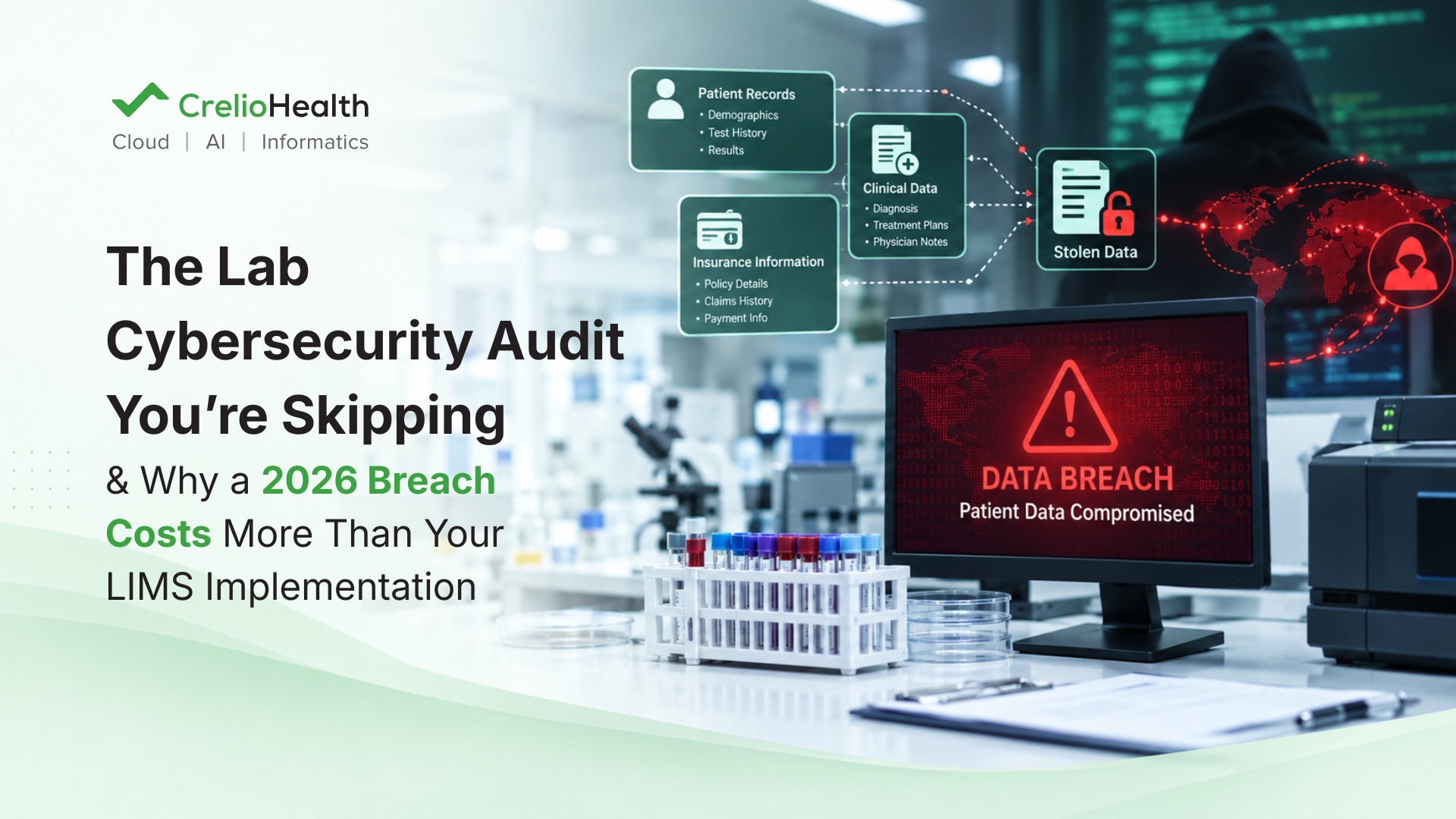

No alarm goes off when a laboratory gets breached. There is no flashing screen, no countdown timer, nothing anyone would recognise from a film. For days, often months, the lab looks completely normal from the inside. Samples get accessioned. Reports go out. Staff log in and out exactly as they always have. Somewhere inside that ordinary traffic, someone who should not be there is reading patient records, mapping the network, and working out what is worth taking.
Here is the part most lab leaders get wrong. The labs that get hit are rarely chosen because they are valuable. They are chosen because they are reachable. One login without a second factor. One server missing a patch. One former employee’s account nobody remembered to close. Attackers are not hunting for the hardest door in healthcare. They are hunting for the one that opens.
This is the lab cybersecurity audit that finds those doors before somebody else does.
Why Diagnostic Labs Are a High-Value Cybersecurity Target
Labs tend to assume they sit below the threshold of interest. A regional diagnostic chain is not a national payer, and a hospital lab is not a bank. That reasoning is comforting and completely wrong, for three reasons that have nothing to do with how large the lab is or how many sites it runs.
I. The Data Is Worth More Than a Credit Card
Clinical lab data carries patient demographics, insurance details, physician-ordered test history, and results. A stolen card number can be cancelled in minutes. A patient’s date of birth, national ID, diagnosis history, and insurance record cannot be reissued at all.
That permanence is what makes lab records valuable for insurance fraud, identity theft, and unusually convincing phishing against patients who have genuinely just had a test done. A message referencing a real test, from a real lab, on a real date is a different proposition from a generic scam email.
It also explains why stolen health records keep circulating years after the breach that produced them. Nothing in that record expires, so nothing about its value decays.
II. Labs Are a Pathway, Not Just a Destination
Few systems in healthcare are as connected as a laboratory. A single lab typically holds live interfaces to hospital records, referring physician portals, reference labs, billing platforms and patient apps.
An attacker who gets into a lab network has not reached a dead end. They have reached a junction with routes into every connected organisation, which makes labs attractive well beyond whatever their own records are worth. The tighter your integrations, the more carefully that pathway needs guarding, a trade-off we unpack in our piece on why data silos break the lab and hospital connection.
III. Healthcare Ransomware Pays Better Than Other Sectors
Ransomware crews price by urgency, and few sectors run as urgently as diagnostics. A lab that cannot release results is a lab where treatment decisions stall, theatre lists slip, and emergency departments quietly start sending samples somewhere else.
That operational pressure is exactly what gets priced into a ransom demand. A manufacturer can lose a week of production and recover. A lab that goes dark for a week has clinicians rerouting work to competitors and patients chasing results nobody can produce.
It is why healthcare has topped IBM’s breach cost rankings for thirteen consecutive years, reaching an average of USD 6.64 million per incident in the 2026 Cost of a Data Breach Report.
The 8-Point Lab Cybersecurity Audit Framework
You do not need a penetration test or an outside consultant to find most of what is wrong. Eight questions, asked honestly, will surface the majority of real exposure in a clinical lab.
One rule makes the difference between a useful audit and a reassuring one. Answer every point with evidence, not assumption. A screenshot, a policy document, a vendor certificate, a log sample. The phrase “I believe so” appears in almost every post-breach report ever written, usually attached to the control that failed.
Stage 1: The Technical Controls
- Multifactor authentication on every clinical system. Confirm MFA is enforced for all LIS and LIMS access, on-site and remote, plus VPN and any email account that receives patient data. The 2024 Change Healthcare intrusion, which ultimately affected 192.7 million individuals, began at a remote access service that simply had no MFA on it. Stolen credentials were enough, and no exploit was needed.
- Endpoint protection and patch management. Every device touching clinical systems needs active endpoint protection and current patches. That includes tablets at collection centres, the reporting machine in the back office nobody has rebooted in months, and any analyser workstation running an operating system the manufacturer stopped supporting. Unpatched systems remain the most common first foothold in healthcare attacks, and lab environments collect them faster than most.
- Network segmentation between clinical and administrative systems. Your analyser network and LIS should sit behind a boundary that a compromised front-desk workstation cannot cross. Test the claim rather than trusting the diagram. If a phishing click in the accounts office can reach the instrument network, your segmentation exists on a network map and nowhere else.
- Encryption of patient data at rest and in transit. Get your vendor’s encryption specification in writing rather than accepting a verbal assurance from a sales call. This single control changes the legal character of an incident: in most jurisdictions, properly encrypted data that is stolen may not trigger a reportable breach at all, while the same records unencrypted almost certainly will.
Stage 2: The Human and Process Controls
- Access controls and a working offboarding process. Role-based access and least privilege are the easy half, and most labs have them configured. The hard half is whether LIS access actually terminates the day someone leaves. Pull a list of active accounts and reconcile it against current payroll. Dormant accounts belonging to former staff are a routine entry point precisely because nobody is watching them.
- Backups that are isolated and actually tested. Ransomware encrypts any backup it can reach, so a permanently attached backup drive is storage rather than protection. Two questions settle this one. Is at least one backup copy offline or otherwise unreachable from the production network, and when did somebody last complete a full restore from it? If nobody can name a date, the recovery plan is a theory.
- Third-party and vendor security review. Every integration is an attack surface, and a vendor’s breach quickly becomes your regulatory event. Ask critical vendors for current SOC 2 Type II, ISO 27001, or HITRUST evidence, written encryption specifications, and their contractual breach notification window. A vendor that cannot produce certification status in writing has already told you something useful. This is one of the questions worth asking before signing any LIS contract.
- An incident response plan somebody has rehearsed. A written plan nobody has exercised will not survive its first real hour, when half the people named in it are unreachable, and the rest are improvising. Run a tabletop exercise at least annually. The plan should name who declares an incident, who contacts regulators and within what deadline, who briefs referring clinicians, and how urgent results keep moving while systems are down.
What a Lab Data Breach Actually Costs in 2026
The cost of a breach is rarely the number people expect, because the ransom or the fine is only one line in a much longer bill. IBM’s 2026 Cost of a Data Breach Report put the global average across all sectors at USD 4.99 million, a twelve percent rise and the highest figure the report has ever recorded. Healthcare sat well above that.
| Cost component | What it covers | What the 2026 data shows |
|---|---|---|
| Detection and escalation | Forensic investigation, crisis management, internal response | The fastest-growing component in IBM’s 2026 report |
| Notification | Regulator filings, patient letters, credit monitoring offers | Scales directly with how many records were exposed |
| Post-breach response | Legal counsel, helpdesk load, penalties, remediation work | Where regulatory fines under HIPAA, GDPR, or DPDP land |
| Lost business | Downtime, referral loss, patient churn, reputational damage | Healthcare averaged USD 6.64 million per breach overall |
Two findings in that report matter more to a lab than the headline figure.
- The first is about speed. Breaches that ran past 200 days before containment cost an average of USD 5.65 million, against USD 4.32 million for those contained faster. The gap is not the attack. It is how long nobody noticed.
- The second is about preparation. Organisations with a tested incident response plan saved an average of USD 2.66 million per breach, which is a larger saving than most labs spend on their entire information systems budget in a year.
Now hold those figures against the alternative. A modern LIMS or LIS implementation carrying enterprise-grade security, meaning MFA, role-based access, encryption at rest and in transit, complete audit trails and recognised certification, sits in the range of tens to a few hundred thousand US dollars depending on lab size, site count and deployment model.
One of those numbers is a planned investment you control and can phase. The other arrives unannounced, on somebody else’s timetable, while your systems are down. The comparison is not close, and it has not been close for several years.
The Regulations That Now Treat Basic Security as Mandatory
Lab cybersecurity used to be framed as best practice, something to get to once the operational work was done. It is now enforceable in most markets a diagnostic lab operates in, and the regime that applies to you matters far less than the expectation sitting underneath all of them.
- HIPAA, United States: Lab HIPAA compliance requires reasonable and appropriate safeguards for patient data, with breach notification obligations and civil penalties attached to findings of neglect.
- GDPR, European Union and EEA: Health data is a special category requiring heightened protection. Portugal’s regulator fined Centro Hospitalar Barreiro Montijo EUR 400,000 in 2018 for excessive access rights, establishing early that sloppy access control alone is actionable.
- DPDP Act, India: The Digital Personal Data Protection Act and its Rules, notified in November 2025, bring consent, data minimisation and mandatory breach notification to Indian healthcare providers.
- ISO 27001 and ISO 15189: Neither is a law. Together they give labs a certifiable information security management framework and the data-control expectations that accreditation assessors already inspect against during routine visits.
Different names and different penalties, but the same three demands every time:
- Control who reaches patient data
- Be able to prove it with records
- Tell the right people quickly when that control fails
For multi-site labs, the second demand is usually the hardest, because proving control means producing consistent evidence from every location rather than from the best-run one. Audit trails sit at the centre of all three obligations, which is why they feature so heavily in how LIMS software automates good laboratory practice.
How to Run This Audit Without Hiring a Consultant
None of this requires a security budget to begin, and waiting for one is how labs stay exposed for years. What it requires is someone senior enough to ask uncomfortable questions and refuse to accept vague answers from either staff or vendors. Work through it in four passes across a month.
- Week one, inventory: List every system holding patient data, every device that reaches those systems, and every third party with a live connection into your network. Most labs find at least one connection nobody currently owns.
- Week two, evidence: Walk the eight audit points and collect proof for each, meaning screenshots, policy documents, vendor certificates, and log samples. Anything you cannot evidence is a gap, regardless of how confident the team feels.
- Week three, triage: Rank gaps by blast radius rather than by effort. Missing MFA on remote LIS access outranks an outdated password policy every time, even though the password policy is easier to fix.
- Week four, rehearse: Run a one-hour tabletop exercise built on a ransomware scenario and talk it through properly. Who declares the incident, who calls the vendor, who notifies regulators and within what deadline, and how does the lab keep releasing urgent results while its systems are unavailable? Write down every question nobody could answer.
Repeat the cycle every six months, and after every major system change. Security posture decays quietly between audits, usually through accumulated exceptions that each seemed reasonable at the time. Where your data physically sits and who administers it changes the shape of this work too, something we cover in our guide to cloud-based lab data management.
Frequently Asked Questions
What is a lab cybersecurity audit exactly?
It is a structured review of how a laboratory protects patient data across systems, devices, staff access, and third-party connections. A useful audit collects evidence for every control rather than relying on assurances, and ends with ranked gaps and owners.
Why do attackers target clinical diagnostic laboratories?
Lab records combine demographics, insurance details, and diagnosis history that cannot be cancelled or reissued like a card number. Labs also hold live connections into hospitals, payers and reference labs, making them a useful route into other healthcare organisations.
Does HIPAA actually require multifactor authentication now?
HIPAA requires reasonable and appropriate safeguards rather than naming specific technologies. In practice, following several high-profile credential-based breaches, regulators increasingly treat missing multifactor authentication on any system holding patient data as a clear security deficiency during investigations.
How much does a healthcare data breach cost?
IBM’s 2026 Cost of a Data Breach Report put healthcare at an average of USD 6.64 million per incident, the highest of any industry for thirteen consecutive years. Costs rise sharply when containment takes longer than 200 days.
What security certifications should a LIS vendor hold?
Ask for current SOC 2 Type II, ISO 27001, or HITRUST evidence, plus written encryption specifications and documented breach notification commitments. A vendor unwilling to share certification status in writing has effectively answered the question already.
How often should a laboratory repeat this audit?
Every six months as a baseline, and immediately after any major system change, vendor addition, or significant staff turnover. Security posture degrades quietly between reviews, usually through small exceptions that accumulate without anyone formally approving them.
Conclusion
The uncomfortable truth about lab cybersecurity is that most breaches are not clever. They are the predictable result of a control that was missing, a patch that was deferred, or an account that stayed open after someone left. Every one of those is findable in an afternoon by somebody willing to ask for evidence instead of reassurance. None of them need a specialist to spot. They need someone with the authority to keep asking after the first comfortable answer. Run the eight points. Write down what you cannot prove. Rank what you find by how much damage it would do rather than how awkward it would be to fix. Then put a date in the calendar to do it again. Know what your own exposure looks like before somebody outside your organisation introduces you to it.

