

Our previous blogs talk about how artificial intelligence (AI) and machine learning (ML) are transforming the field of medical diagnostics. By leveraging vast amounts of medical data, these technologies enable faster, more accurate diagnoses and patient treatment recommendations. In addition, AI, ML, and Statistical Analysis of Laboratory Data are crucial in improving lab testing and reporting.
Furthermore, there is continuous growth in the complexity and volume of healthcare data. Hence, analytical lab data has become an indispensable aspect of diagnostic medicine. Clinical Laboratory Analytics primarily concentrates on various factors. Such factors include diagnosis and treatment recommendations, patient engagement and adherence, and administrative activities.
Laboratory analytics also increase labs’ profitability by reducing the time and resources needed to process lab operations and analyze lab testing results. Automating lab data analysis and reporting with AI and machine learning helps in lab operations management more accurately, saving time and reducing costs. This leads to better efficiency and cost-effectiveness.
We just touched the surface and have built a premise for understanding the importance of laboratory data and insights. Further, let’s analyze laboratory data and insights for medical diagnosis. We will start with learning about the Data in healthcare. We will also assess how lab data analysis reports can improve the diagnostic and clinical analytics business.
I. What is Data in Healthcare?
Talking about Data in Healthcare, we understand that it is a collection of unprocessed facts and statistics. This includes numbers, text, photos, audio, and video. Also, multiple sources like sensors, software, databases, or humans generate and collect this data.
In healthcare, data collection sources include electronic health records (EHRs), medical devices, wearables, and patient-reported outcomes. Moreover, clinical information like laboratory tests, vital signs, prescriptions, diagnoses, and administrative information, like billing codes and insurance claims, can also be included in this data.
II. Lab Data Analysis and Management: Impact on Diagnostics and Patient Outcomes
Analysis of Laboratory data and insights is like having a crystal ball that can predict and deliver better care and improve patient outcomes. Healthcare providers analyze large amounts of healthcare data, including patient records, treatment plans, and medical research. This helps them to identify patterns and connections that were previously impossible for humans to see.
Imagine being able to examine an enormous volume of patient data, and spot trends and correlations. Further, being able to develop tailored treatment regimens that can prevent death. As lab analytics and healthcare technology evolve, we can anticipate increasingly more precise predictions and in-the-moment insights that can aid medical professionals in taking early action and ensuring the prevention of certain illnesses. Along with this, lab testing and reporting are essential components of the lab data analysis process that enable accurate disease detection and timely treatment.
III. Using Analytical Lab Data and Insights: Improve Lab Testing and Reporting
Reducing costs, improving patient outcomes, and streamlining lab operations are priorities in the healthcare industry. Laboratory Data and Insights are essential to efficiently achieve these goals.
Laboratory Data Analysis interprets large data sets to extract useful information and insights. It involves applying various statistical and computational techniques to explore and understand data patterns, trends, and relationships. The phases of the lab data analytics life cycle consist of a series of stages, including data collection, preprocessing, exploratory data analysis, model building, and deployment.

IV. Phases of Data Analytics Life cycle
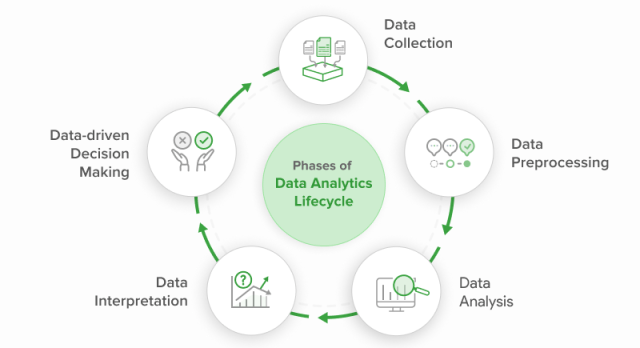
1. Data Collection for Lab Testing:
The initial step in the data analytics lifecycle is data collection, which requires gathering information from various sources, including laboratory equipment, lab data testing, electronic health records, and other healthcare systems.
2. Data Preprocessing:
Next to data collection, this step includes cleaning and processing the data to ensure it is correct and suitable for statistical analysis of laboratory data. At this step, duties like eliminating duplicates, adding missing numbers, and formatting data uniformly are all part of the lab operations management.
3. Data Analysis:
Further after data cleaning and preprocessing, the data analysis and reporting phase follows. This uses statistical and machine learning algorithms to gain insights and identify patterns. Researchers and analysts use descriptive statistics, inferential statistics, clustering, and classification techniques to analyze data.
4. Lab Testing Data Interpretation:
Next, after completing the statistical analysis of laboratory data, it is necessary to effectively interpret and communicate the findings to stakeholders. Lab reporting involves presenting the results clearly and concisely and providing actionable insights to support decision-making.
5. Data-driven Decision Making:
Lastly, Data-driven decisions are made in the final step of the data analytics lifecycle, using the insights gained from clinical analytics. This develops new testing and lab reporting protocols, improves patient care, and enhances the quality of healthcare delivery.
Diagnostic laboratories can increase the precision and effectiveness of laboratory tests using laboratory analytics to find patterns and trends in patient data. As a result, it can certainly contribute to making fewer mistakes, quicker turnaround times, and better patient outcomes.
Diagnostic laboratories can also find process and cost optimization areas with lab analytics. Additionally, they can find areas facing inefficiencies and optimize resource allocation. Clinical laboratory analytics can examine operational data such as test volumes, turnaround times, and staffing levels to reduce costs and improve efficiency. After delving deep into the topic of Laboratory Data Analysis, let’s learn about the benefits of clinical laboratory analytics.
V. 10 Benefits of Clinical Laboratory Analytics: Transforming Lab Operations
1. Better patient outcomes:
The use of advanced Clinical Analytics can help organizations identify areas for improvement in patient care. Patient health data analytics results in better outcomes and higher patient satisfaction.
2. Enhanced clinical decision-making:
Healthcare professionals can make more informed decisions about diagnosis, treatment, and care plans with the help of analytical lab data reports.
3. Increased efficiency:
Clinical laboratory data analytics may assist related businesses in streamlining procedures, optimizing resource allocation, increasing effectiveness, and cutting costs.
4. Improved population health management:
Clinical data analytics assist healthcare organizations in identifying and addressing health trends and dangers in specific populations, thus improving community health outcomes.
5. Personalized medicine:
Medical experts can create individualized treatment plans based on each patient’s unique needs and medical history by evaluating their laboratory analytics reports. This leads to more effective therapies and better patient outcomes.
6. Improved quality of care:
Laboratory Data Analysis and Reporting can track and measure the quality of care in the healthcare industry. The lab analytics of this data can result in better clinical outcomes and patient safety.
7. Cost savings:
Clinical Laboratory Analytics may assist healthcare businesses in cutting costs and increasing efficiency by identifying areas for process improvement and cost reduction under lab operations management.
8. Advanced research and development:
Utilizing laboratory data and insights can favor the development of novel medications and treatments, improving patient care and health outcomes through cutting-edge research and development.
9. Predictive analytics:
Clinical Data Analytics for healthcare organizations can assist in predicting and preventing health problems before they arise, improving patient outcomes, and lowering expenses.
10. Improved patient engagement:
The use of clinical laboratory data analytics can increase patient engagement and satisfaction by employing patient data analysis to tailor care and give patients pertinent health information.
Conclusion
Clinical Laboratory Data Analytics greatly improved healthcare by allowing for quicker and more accurate analysis of large amounts of data. This has led to personalized treatment, better patient outcomes, and reduced costs. Furthermore, laboratory analytics in healthcare will become increasingly important in lab testing and reporting as healthcare data grows.
In this series of 3 blogs, we tried to achieve a thorough understanding of cutting-edge technologies like artificial intelligence, machine learning, and lab data analytics. Also, subscribe to our newsletters to keep up with the constantly evolving technology trends and advancements in lab operations management and laboratory business.
For any suggestions on what you want to read next, feel free to comment. Your learning interest is what keeps us going to create valuable content.


