
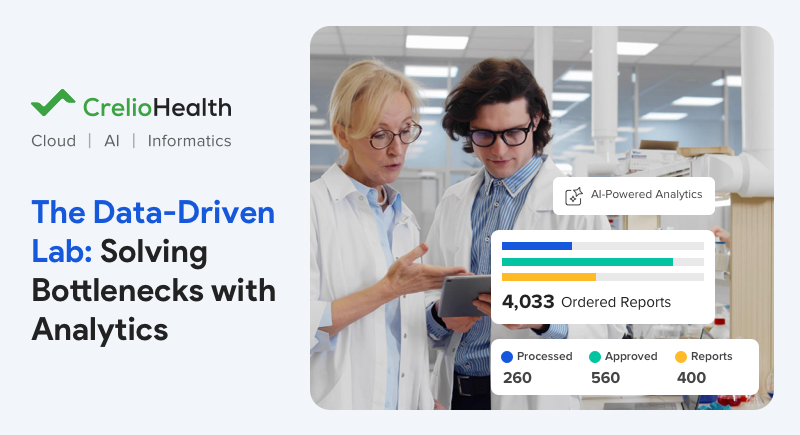
Modern laboratory workflows have become increasingly complex, driven by rising test volumes, multi-instrument environments, and distributed operations. Parallely, diagnostic demand has grown by 20–30% in recent years, while staffing and infrastructure have not kept pace. These segmented complexities make lab bottlenecks harder to detect than ever.
Most delays today are not obvious; they occur between workflow stages such as accessioning, validation, or reporting. This challenging part of the distributed and complex operational stages creates silent bottlenecks that are extremely difficult to detect through manual tracking or static reports.
What modern labs require here is a micro-level, real-time insight into lab operations with complete data tracking, transparency, and analytics. These assist labs in detecting inefficiencies early and acting proactively. The blog illustrates these issues in detail.
1. The Growing Operational Complexity in Modern Laboratories
Laboratory workflows involve multiple interconnected stages, where even minor inefficiencies can disrupt downstream processes. Since each step depends on the accuracy and timeliness of the previous one, a single delay can ripple across the entire workflow.
With over 70% of clinical decisions dependent on lab results, the pressure to deliver fast, accurate results continues to increase.
For example, inaccuracies during accessioning can lead to rework, directly affecting testing timelines and report delivery. Such dependencies make it essential for labs to maintain seamless coordination across all stages.
However, many laboratories struggle with fragmented data and limited visibility into operations. This makes it difficult to clearly determine:
- The exact stage where delays begin
- Whether inefficiencies stem from process gaps or resource constraints
Without this clarity, resolving performance issues becomes significantly more challenging.
2. Understanding Bottlenecks in Laboratory Workflows
A bottleneck is any point in the workflow that restricts overall efficiency and slows down output. In laboratory environments, these constraints are dynamic and often shift based on workload, staffing levels, and system performance.
Common bottlenecks include:
- Sample accessioning delays due to manual entry or incomplete requisitions
- Instrument imbalance, where some analyzers operate at >90% capacity while others remain underutilized
- Validation backlogs, which can increase turnaround time by 20–30% in high-volume labs
- Reporting delays caused by manual or inefficient communication processes
Pre-analytical errors alone account for up to 70% of laboratory errors, making early-stage inefficiencies particularly critical. Over time, these issues compound, increasing turnaround time (TAT) and operational pressure.
Know how to prevent bottlenecks from the pre-analytical phase, by Industry Leader, Dr. Ravi Gaur.
3. Why Old-School Monitoring Methods Fall Short
Conventional monitoring approaches, such as periodic reports and spreadsheets, provide only a limited view of laboratory performance. While they may highlight past trends, they lack the ability to capture ongoing workflow fluctuations.
This results in several limitations:
- Issues are identified only after they have already impacted the turnaround time
- There is no continuous visibility into workflow performance
- Root causes of recurring inefficiencies remain difficult to pinpoint
Due to these gaps, laboratories often end up responding to problems after they occur, rather than preventing them through timely intervention.
4. The Rise of the Data-Driven Laboratory
A data-driven laboratory uses analytics to monitor operations continuously and guide decision-making. Instead of relying on assumptions, labs leverage real-time data to optimize workflows.
This approach is defined by:
- Continuous tracking of workflow metrics
- Real-time dashboards for performance monitoring
- Data-backed operational decisions
Laboratories adopting analytics-driven practices report 20–30% improvements in efficiency, along with better resource utilization and faster turnaround times.
5. Potential Bottlenecks in the Lab Workflow
Bottlenecks can occur at any stage of the laboratory workflow, often in areas that lack visibility or automation.
- Sample Collection: Labeling errors or incomplete patient details
- Accessioning: Manual data entry delays and administrative backlog
- Processing & Preparation: Inefficient sample handling or sorting delays
- Testing: Analyzer overload or equipment downtime
- Validation: Manual verification is slowing report approval
- Reporting: Delays in report delivery due to a lack of automation
A delay at any stage creates a cascading effect. For example, even a 15–20 minute delay in accessioning can lead to hours of delay in reporting during peak workloads. Analytics tools help pinpoint exactly where these slowdowns occur.
6. Top Metrics to Track for Detecting Bottlenecks
Tracking the right metrics is essential for identifying inefficiencies and improving performance. Rather than relying on broad observations, data-driven labs monitor specific indicators.
Key metrics include:
- Turnaround Time (TAT): Measures end-to-end efficiency; reducing TAT by 10–15% significantly improves service quality
- Sample Processing Time: Identifies delays in early workflow stages
- Instrument Utilization Rate: Ideal range is 70–85%; higher leads to backlog, lower indicates underuse
- Sample Queue Length: Highlights congestion at specific stages
- Result Validation Time: Tracks delays between testing and approval
- Error and Rework Rate: Even a 1% error rate can impact throughput at scale
- Staff Productivity: Helps balance workload and improve efficiency
These metrics provide a comprehensive, real-time view of lab operations.
7. How Analytics Helps Fix Bottlenecks
Analytics enables laboratories to move from identifying problems to solving them with precision. By analyzing workflow data, labs can pinpoint inefficiencies and take targeted action.
Key outcomes include:
- Accurate identification of delay points across workflow stages
- Improved instrument utilization through workload balancing (15–25% improvement)
- Better staffing decisions based on workload trends
- Reduction in turnaround time by up to 30–40% through process optimization
In practice, this means:
- Accessioning delays can be reduced by identifying administrative bottlenecks
- Analyzer workloads can be redistributed to avoid overload
- Validation backlogs can be addressed through real-time alerts
This approach transforms lab operations from reactive to proactive.
8. Technologies Enabling Data-Driven Laboratories
The shift to data-driven operations is supported by integrated technologies that provide visibility and intelligence.
- Laboratory Information Systems (LIS/LIMS) centralize workflow and operational data
- Real-time dashboards provide visibility into performance metrics and bottlenecks
- AI-powered analytics enable predictive insights and early detection of anomalies
These technologies work together to create a connected ecosystem where data flows seamlessly across processes.
9. Strategic Value of Analytics in Laboratory Management
Beyond operational improvements, analytics provides strategic advantages that support long-term growth. It enables faster decision-making by providing real-time insights, allowing managers to act immediately rather than waiting for reports. It also improves resource planning by helping labs anticipate workload fluctuations and allocate resources more effectively.
Over time, continuous monitoring leads to higher operational efficiency, reduced waste, and improved service quality. Many laboratories report 20–30% efficiency gains within the first year of adopting analytics-driven approaches.
Conclusion: From Reactive Labs to Intelligent, Data-Driven Operations
Laboratories are moving toward a model where data drives every decision. With advancements such as predictive analytics, AI-driven staffing, and real-time alerts, operations are becoming more proactive and efficient.
The shift is clear from delayed insights to real-time visibility, and from reactive fixes to continuous optimization. While bottlenecks are inevitable in complex workflows, analytics ensures they are identified and resolved quickly.
The future belongs to laboratories that can turn operational data into actionable insights and consistently translate those insights into measurable performance improvements.

