
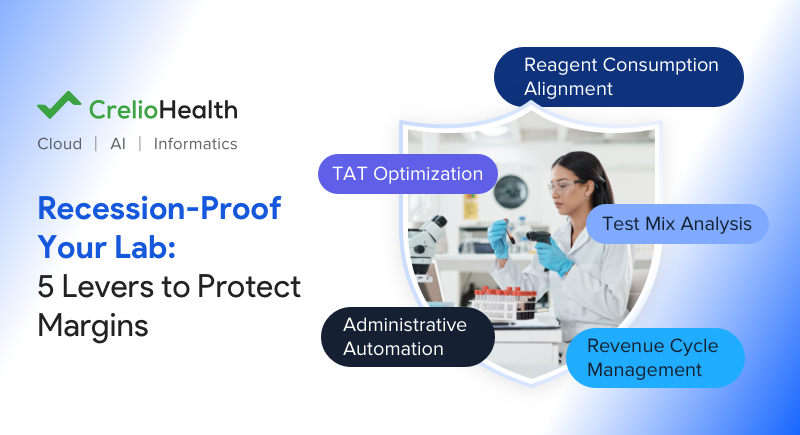


Labs across the country ended 2025 in a financial squeeze that is impossible to ignore. A proposed 3.4% CMS fee reduction is colliding with aggressive payer denials, which drove a massive $48.4 billion in net revenue leakage last year, according to Kodiak Solutions. Even robust labs with disciplined billing teams are feeling the hit, with ADS data showing year-over-year revenue declines of up to 12%. The core problem is structural: roughly two-thirds of a clinical lab’s cost base is fixed. When testing volume drops, revenue plummets instantly while sticky overhead costs barely budge, amplifying the margin hit before leadership can even react.
The labs navigating this crisis successfully are not the ones simply cutting the hardest. Instead, they are the lab businesses that built deep operational visibility before they actually needed it, and they are aggressively pulling five specific levers right now to protect their lab profit margins.
1. The Lab Cost Structure Problem: Why Volume Drops Hurt More Than They Should
Most lab leaders understand that their cost structure is largely fixed. What surprises them is how fast that fixed cost base turns into a margin crisis when volume softens by even 10 to 15%. The fixed-to-variable cost ratio in clinical labs is structurally unforgiving. In a typical mid-sized lab operation, staff, equipment leases, facilities, and IT lock in 60 to 70% of your cost base before a single sample is processed. Reagents, consumables, and send-out costs make up the remaining 30 to 40%. In a growth environment, this structure rewards scale. But during a volume decline, it affects you immediately.
When volume drops 15%, revenue falls 15%. But with 65% fixed costs, total expenses decline only 5.25%. The operating margin gap widens by 9.75 percentage points overnight.
The labs that navigate this best are not those with the lowest overhead. They are the ones that know, in real time, exactly where every dollar is going and which operational variable to adjust first. That visibility is not a reporting function. It is a competitive asset.
2. The 5 Operational Levers High-Resilience Labs Are Pulling Right Now
In the volatile healthcare market, agility is the ultimate competitive advantage. The five strategies below aren’t theoretical; they require real-time data access and relentless operational discipline. Labs moving the needle right now have the LIMS infrastructure and analytics maturity required to execute shifts in days, leaving those who plan by the quarter far behind.
Lever 1: Real-Time Reagent Consumption Alignment
When volume softens, the first cost category to bleed is reagent inventory purchased against volume projections that no longer hold. Labs running manual purchasing cycles will over-order for weeks before anyone notices the shortfall. That waste is pure margin erosion with no clinical benefit.
What high-performing labs do differently:
- Tie purchasing triggers directly to actual test consumption data inside the LIMS, not to periodic manual counts or static forecasting models.
- Set dynamic reorder thresholds that adjust automatically when 7-day volume trends fall below a defined baseline.
- Track reagent utilization by test type and analyzer to systematically capture and reduce waste from calibration runs and expired lots.
- Review send-out costs weekly during low-volume periods since reference lab fees are a variable cost category that inflates quickly when internal volume drops and batching efficiency falls.
The LIMS is the platform that makes this possible in real time. Without instrument-level consumption data feeding directly into procurement decisions, you are always reacting one billing cycle too late.
Lever 2: TAT Optimization to Defend Referring Physician Loyalty
When volume is under pressure, the correct instinct is not to cut. It is to protect what you have. And what you have is built on physician confidence in your turnaround time. The stakes are clear: if a referring physician waits three days for a routine result, they will not complain. They will quietly route the next patient elsewhere.
Operational steps that actually move the needle:
- Measure TAT at every handoff point: collection, receipt, analysis, validation, and report delivery. Pre-analytical delays account for 60 to 70% of total TAT variance in most clinical labs. That is where to start.
- Segment TAT by test type, collection center, and ordering physician. Aggregated averages hide the outliers that are quietly damaging referral relationships.
- Identify which collection centers are responsible for delayed specimen receipt and intervene with route optimization or phlebotomist scheduling changes before the volume walks.
- Set internal TAT benchmarks below the industry standard. Best-in-class outpatient labs are targeting under 8 hours for routine panels. If your benchmark is still 24 hours, you are setting yourself up to lose on performance in a competitive environment.
Lever 3: Test Mix Analysis to Protect Your Margin-Positive Volume
Not all volume is worth protecting at the same cost. During a downturn, labs that lack test-level profitability data make the same mistake: they defend total volume instead of defending margin-accretive volume. The result is cost allocation and sales effort spent retaining low-margin panels while high-margin specialty work shifts to a competitor.
What margin-aware labs are doing:
- Build a test-level P&L that captures direct costs: reagent cost per run, instrument amortization per test, technologist labor allocated by test complexity, and send-out fees where applicable.
- Classify every panel into one of three tiers: positive margin, break-even, or negative margin. Review this classification quarterly since reagent contracts and reimbursement rates both shift.
- Focus retention and outreach efforts on physicians who order high-margin panels. Routine chemistry volume from a high-denial payer at low reimbursement rates is not worth the same protection as molecular and specialty testing.
- Flag panels where the reimbursement rate from a specific payer consistently falls below the fully-loaded cost. These are margin drains that become more dangerous as volume declines and fixed cost absorption weakens.
Labs without test-level profitability visibility inside their LIMS are flying blind when volume pressure hits. The data exists in your system. The question is whether it surfaces in a format that drives decisions.
Lever 4: Administrative Automation to Reduce Labor Overhead Without Cutting Clinical Capacity
The instinct in the face of volume decline is to reduce clinical headcount. That is almost always the wrong target. Clinical capacity is what earns revenue. Administrative labor embedded in manual workflows is where the fat is.
In most mid-sized labs, manual processes account for a significant share of total administrative hours: manual report dispatch, manual billing reconciliation, manual QC documentation, manual insurance eligibility verification, and manual follow-up on outstanding claims. Each of these is an automation candidate.
Specific automation targets with high return:
- Automated report delivery: digital dispatch to physicians and patients via portal, email, or WhatsApp eliminates manual printing, sorting, and courier coordination. For labs still handling physical report distribution, this is a direct headcount reduction opportunity.
- Automated QC documentation and flagging: LIMS-driven QC workflows reduce technologist time spent on manual QC recording and create an audit-ready trail without additional administrative burden.
- Automated billing workflow: electronic eligibility verification at the time of registration, claim scrubbing before submission, and automated follow-up queues for open AR items all reduce the manual labor load on billing staff during the periods when claim volume and complexity are highest.
- Shift scheduling tied to volume forecasting: matching shift capacity to predicted daily test volume using historical LIMS data reduces overtime and temp labor costs, which spike during the low-volume periods when labs are most vulnerable.
Lever 5: Revenue Cycle Optimization to Capture Every Dollar of Earned Revenue
Volume pressure makes revenue leakage unaffordable. Yet 2025 data from Kodiak Solutions shows the average initial denial rate reached 11.6%, and net revenue leakage increased by 25% year over year. More concerning: industry analysis consistently shows that 35 to 60% of denied claims are never resubmitted. That is earned revenue permanently abandoned.
In 2025, net revenue leakage across 2,300 hospitals reached $48.4 billion, up 25% from 2024. Clinical denials, including lack of prior authorization and medical necessity failures, accounted for virtually all of the increase.
Revenue cycle levers that protect margin during volume pressure:
- Automated claim scrubbing at submission: catching eligibility failures, missing codes, and payer-specific rule violations before a claim goes out eliminates the most common denial causes before they enter the denial management workflow.
- Real-time denial categorization: sorting denials by root cause, payer, and test type at the point of receipt allows billing teams to prioritize high-dollar, high-recovery-probability appeals instead of working the queue sequentially.
- Payer-specific rule libraries: coding and documentation requirements differ significantly by payer. Labs with payer-specific logic built into their billing system avoid the clinical denial categories that accounted for virtually all of the 2025 leakage increase.
- Proactive prior authorization workflows: for panels with known prior authorization requirements from high-denial payers, front-end authorization checking before the specimen is collected eliminates downstream clinical denials entirely.
3. The Non-Negotiable Prerequisite: Lab Operational Data Visibility
Every one of these five levers requires real-time data. Reagent optimization requires consumption data by test and instrument. TAT improvement requires timestamped handoff data at every workflow stage. Test mix analysis requires test-level cost and reimbursement data. Automation requires workflow data to identify manual steps. Revenue cycle optimization requires denial data segmented by payer, test, and denial reason.
The question to ask your leadership team right now: can your lab answer these five questions today, without pulling a report or waiting for a monthly close?
- What is our reagent consumption rate per test type this week, and how does it compare to the same period last month
- What is our average TAT by collection center over the past 14 days, and which centers are outliers?
- Which of our top 20 panels are operating at negative or break-even margins at current reimbursement rates?
- What percentage of our administrative labor hours last week were spent on tasks that could be fully automated?
- What is our denial rate by payer this month, and what is the dollar value of claims currently past 30 days with no action?
If the honest answer to more than two of those questions is ‘I do not know’ or ‘we would need to run a report,’ your lab does not have the operational data infrastructure to execute a margin defense strategy when volume pressure arrives. You have a reporting system. That is not the same thing.
Ending Note
With payer denials driving $48.4 billion in lost revenue in 2025, CMS cutting the Clinical Laboratory Fee Schedule again, and year-over-year revenue declines hitting even well-run labs by 7 to 12%, the labs that come out of this cycle intact will not be the ones that reacted fastest. They will be the labs that built operational data visibility into their LIMS before the pressure arrived, so that when volume softened, every one of these five levers was already pullable. Reagent alignment, TAT defense, test mix clarity, administrative automation, and revenue cycle discipline are not emergency measures. They are operating standards. The labs treating them that way right now are the ones you will be competing against in two years.

