
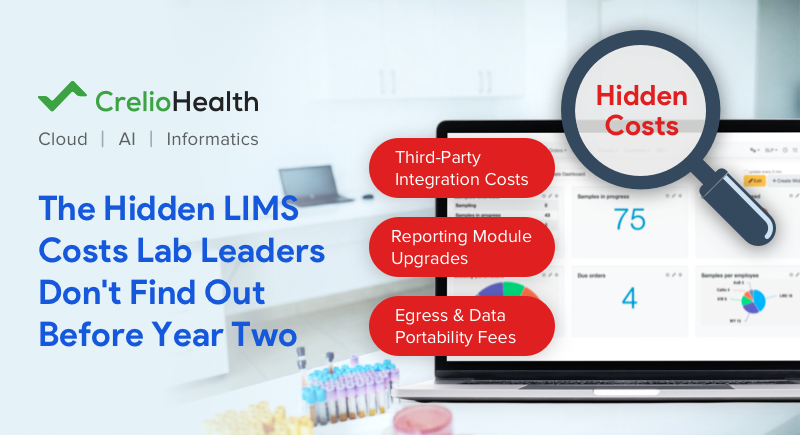
That headline number on the vendor proposal is not the cost of your LIMS. It is the cost of getting started with it. The real figure, including LIMS implementation costs, instrument interfacing, staff re-training, and storage overages, almost always arrives in year two, buried in invoices your finance team wasn’t expecting. Research consistently shows that for mid-size diagnostic labs, license fees account for as little as 35% of the five-year total cost of ownership, leaving the remaining 65% scattered across line items that were either buried in contract footnotes or never discussed at all. This article breaks down every major hidden cost category in LIMS pricing, gives you a structured framework for calculating the true total cost of ownership, and equips you with the exact questions that separate pricing-transparent vendors from the ones who let you find out the hard way.
1. The Anatomy of a LIMS Quote: What You See vs. What You Pay
Vendor quotes are architected around the minimum viable scenario. Your lab’s actual scenario is rarely minimum viable, and that gap is where costs accumulate.
I. The Headline LIMS Pricing Is a Floor, Not a Ceiling
Most LIMS vendors structure quotes around a per-seat, per-test, per-center, or flat-tier model. What they present is the theoretical minimum configuration, not what a functioning multi-analyzer, multi-center diagnostic lab actually needs to run. Cloud-based LIMS pricing in 2026 ranges from $40 to $300 per user per month, and on-premise deployments routinely demand $50,000 to $250,000 in upfront licensing before a single instrument goes live. The headline is simply your entry ticket.
The Five Components Most Quotes Leave Out
Before any LIMS implementation cost conversation gets serious, check whether your quote explicitly addresses these five items.
- Implementation and Configuration Fees: Often billed hourly post-contract at $150 to $300 per hour. For complex lab environments, this alone can run into tens of thousands before your first test result is processed through the new system.
- Instrument Integration Charges: Each analyzer interface is frequently a separate line item. A lab running eight instruments can accumulate $20,000 to $60,000 in interface fees that were never mentioned during the sales process.
- Training Costs for Staff Turnover: Go-live training is sometimes bundled. Re-training for new hires hired six months after implementation is rarely included and is consistently underestimated in the budgeting phase.
- Data Migration Fees: Moving structured historical data from a legacy LIMS or paper-based system into a new platform is a specialized, time-intensive service. Expect this to be priced separately and often unexpectedly.
- Custom Report Formatting: Standard report templates are included. Your lab’s specific patient report format, referral partner layout, or regulatory submission template will likely trigger a professional services fee.
2. The 10 Hidden Cost Categories: A Line-by-Line Audit
A rigorous LIMS price comparison cannot stop at subscription fees. These ten cost categories are where the actual financial risk lives.
I. Interface Build & Maintenance Fees:
Most vendors charge per instrument interface, not just for setup but for annual maintenance and every firmware update. A diagnostic lab with eight analyzers can easily absorb $20,000 to $60,000 in annual LIMS hidden fees that never appeared in the initial proposal.
II. Data Storage Overages:
Cloud LIMS solutions price a base storage tier and charge for overages. High-volume labs or those storing digital imaging data routinely breach those limits within 18 months. Always ask for a projected data footprint estimate for year three before signing.
III. API Access and Integration Costs:
Connecting your LIMS to your EHR, billing platform, or referral partner’s system often triggers per-API-call or per-integration charges. This is the silent integration tax that consistently inflates the LIMS implementation pricing beyond what any procurement manager anticipated.
IV. User License Tier Jumps:
Pricing tiers carry artificial ceilings. Adding a new collection center or a group of phlebotomists can push your lab into the next pricing tier, triggering a cost jump that feels entirely disproportionate to the operational expansion being made.
V. Support Level Premiums:
Basic support is bundled. Priority support, where a critical system failure is addressed in under four hours, is frequently a premium add-on that labs discover they need only after their first downtime incident during peak testing hours.
VI. Compliance and Audit Module Fees:
Features required for 21 CFR Part 11, CLIA, and CAP compliance, including immutable audit trails, electronic signatures, and role-based access controls, should be core infrastructure. In many vendor packages, these are paid add-ons. Never sign without confirming these are included in the base price.
VII. Training and Change Management:
Implementation training typically covers the go-live window. Ongoing training for new staff, module additions, and annual competency documentation are billed separately in nearly every LIMS contract, adding materially to the LIMS implementation cost every year the platform is in use.
VIII. Business Intelligence and Reporting Upgrades:
Operational dashboards, cross-center analytics, and custom KPI tracking are almost universally a premium tier. Labs that need actionable performance data, not just raw results, typically find themselves upgrading within the first 12 months after go-live.
IX. Contract Escalation Clauses:
Read your renewal terms carefully. Many vendors include CPI-indexed or unilateral escalation clauses that raise your annual contract by 8 to 15% without requiring renegotiation. Modeling your year three and year five costs, not just year one, is the only way to protect your LIMS pricing long term.
X. Exit and Data Portability Fees:
If you decide to migrate to a new vendor, what does it cost to export your data in a usable format? Some vendors charge extraction fees at contract termination, a lock-in mechanism that functions as a financial penalty for switching rather than a legitimate service.
3. The Total Cost of Ownership Framework: How to Compare Apples to Apples
LIMS price comparison done on headline numbers alone is how labs end up locked into expensive contracts they regret. TCO is the only number that tells you what you’re actually committing to.
I. The Five-Year TCO Model
Industry data puts five-year LIMS spending for growing diagnostic labs between $40,000 and $120,000, with mid-size labs ranging from $120,000 to $400,000, and enterprise lab networks exceeding $1 million. For one documented mid-size lab, the license fee over five years was $401,000, just 35% of the total ownership cost. The remaining 65% covered implementation, integrations, internal resources, and ongoing operations. Build your TCO model using this formula and apply it consistently across every vendor you evaluate.
Five-Year TCO = Year 1 Implementation + (Annual License x 5) + Integration Fees + Training + Support Upgrades + Anticipated Storage and Usage Overages
This is the number that should drive your LIMS price comparison, not what is on page one of the proposal.
II. The Questions That Expose Vendor Pricing Integrity
Any vendor that cannot answer these questions clearly, and in writing, is signaling a pricing model that profits from your uncertainty.
- Scaling Costs at New Centers: Ask exactly what happens to your pricing when you add a third collection center. The answer reveals how aggressively the contract tiers are structured and whether growth will be penalized.
- Instrument Interfacing Inclusion: Confirm whether instrument interfacing is included or priced per interface. This single line item, if charged separately, can add $20,000 to $60,000 annually to a lab running multiple analyzers across departments.
- Data Portability at Termination: Ask for the exact data export terms at contract end. Any vendor that hedges on this or routes you back to a professional services conversation is showing you a retention mechanism you will pay dearly to exit.
- Support Tier Upgrade Rate: Ask what percentage of customers upgrade their support tier in year one. A high number is a direct indicator that the base support level is inadequate for production clinical lab environments.
- Average Year-Three Spend: Ask what their average customer pays annually by year three. This question, answered honestly, is the most accurate predictor of your long-term LIMS implementation pricing reality, not the demo-day quote.
Conclusion: The Actual Price of a LIMS Is What You Pay Over Five Years
Lab leaders who make LIMS decisions on headline pricing alone consistently find themselves renegotiating budgets, managing stakeholder expectations, and absorbing costs they were never briefed about. The LIMS hidden fees are not always intentional, but they are predictable, and you can protect your lab by modeling the five-year total cost of ownership, demanding itemized proposals, and holding vendors to written answers on the questions that matter. When you evaluate how much a LIMS system costs with the same financial rigor you apply to capital equipment decisions, you make a choice that delivers sustainable returns rather than annual budget surprises. If you want pricing that comes with zero surprises, ask your LIMS vendor to walk you through a transparent LIMS pricing quote with a five-year cost model built around your lab’s actual size and configuration, before you sign anything.

