
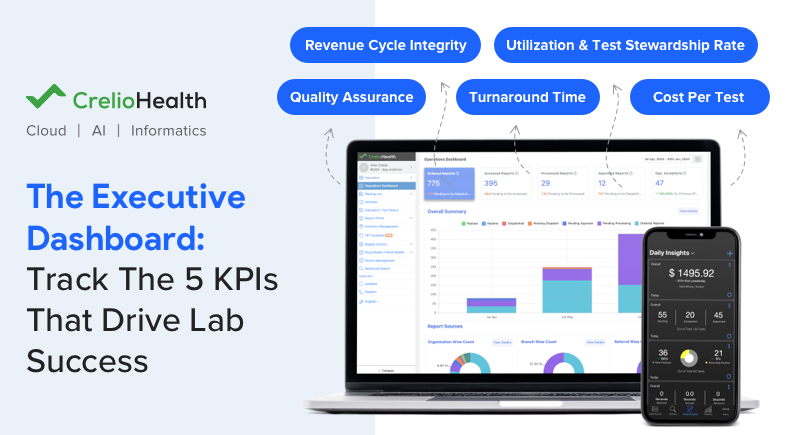
For many years, clinical laboratories stood simply as cost centers; necessary, but not central to the hospital’s strategic business value. Over the past decade, that perception has shifted dramatically. As diagnostics drive over 70% of clinical decisions, the lab has emerged as a strategic asset for patient care, clinical quality, and risk management.
Progressive health systems now recognize that the lab is more than a back-office function. It is a strategic business unit. To fully unlock this value, executive teams need dashboards built around laboratory KPIs that measure lab efficiency, highlight opportunities to improve lab efficiency, and clearly connect lab performance to margins, outcomes, and enterprise-wide growth.
This blog explains the five essential laboratory KPIs that, when tracked and acted upon, can significantly improve lab efficiency and drive lab success across the health system.
Lab KPI 1: Turnaround Time (TAT) for Critical Results
What It Measures
Turnaround Time (TAT) tracks the total time from when a sample is collected to when the final, verified result is delivered to the ordering physician. Most high-performing labs stratify this metric by care setting, such as Emergency Department (ED), Intensive Care Unit (ICU), inpatient, and outpatient.
TAT is one of the most visible ways to measure lab efficiency because it reflects how quickly the lab converts a clinical question into an answer.
Why It Matters to the Executive
Delayed decisions translate directly into financial loss. When lab results take too long, patients remain in beds longer, imaging schedules stall, discharge orders get delayed, and staff time is wasted.
Faster TAT isn’t just a clinical benefit; it is a business lever for lab success.
Target Metric Focus
- “Door-to-Result” Time for Critical Tests: For urgent tests such as Troponin, Blood Gas, or STAT Chemistry, fast turnaround times can make the difference between quick discharge and prolonged hospitalization.
- LOS Correlation: Studies and operational data often show a direct link between lab delays and additional hospital days. A delayed lab report can delay discharge orders, diagnostic decisions, or therapeutic interventions.
Executive Actionable Insights
To enhance lab efficiency and reduce LOS, executives should:
- Audit and map the lab process from sample collection to result reporting, identifying bottlenecks.
- Focus on pre-analytical delays (collection, transport logistics) and post-analytical delays (result validation, reporting workflow).
- Invest in process improvements. For instance, using point-of-care instruments, pneumatic tube systems, or real-time alerting dashboards for STAT results.
KPI 2: Cost Per Test (CPT) – Fully Loaded
What It Measures
Fully loaded Cost Per Test (CPT) calculates the true cost of delivering a single lab result. Unlike basic supply tracking, this metric includes:
- Reagents and controls
- Consumables
- Labor
- Equipment depreciation
- Middleware and LIMS expenses
- Facilities and utilities
This is a financial lab KPI designed to expose the real economics of testing.
Why It Matters to the Executive
Laboratories often underestimate their true cost structure because labor and overhead are hidden across departments. A fully loaded CPT provides finance and operations leaders a single, reliable way to measure lab efficiency at the financial level.
Target Metric Focus
- Labor Utilization Rate: Measures the average time a technologist or technician spends per result, including hands-on time, quality control, result validation, and documentation.
- Volume-Adjusted Cost: Demonstrates how CPT changes with testing volume. Higher volume often reduces per-test costs due to economies of scale; conversely, low-volume or infrequent assays may reveal inefficiencies or oversized fixed costs.
Executive Actionable Insights
Using CPT analysis, leadership can make strategic operational decisions that contribute to improving lab efficiency and protecting margins :
- Automate high-volume assays to reduce labor cost per test.
- Consider outsourcing or batching low-volume, high-cost assays to a reference lab to avoid high CPT overhead.
- Negotiate bulk-purchasing agreements for reagents and supplies to reduce per-test consumable costs.
KPI 3: Utilization and Test Stewardship Rate
What It Measures
This KPI assesses the appropriateness of test ordering. It identifies unnecessary duplicate orders, test orders outside standard clinical indications, or tests with low clinical utility given recent prior results or guidelines.
Inappropriate utilization is a silent drain on both quality and finances.
Why It Matters to the Executive
Unnecessary or inappropriate ordering – “margin leakage” – raises the lab’s CPT, wastes consumables, burdens instruments, consumes labor, and may even cause unnecessary follow-up procedures or patient anxiety (e.g., false positives). It erodes both operational and financial efficiency.
Target Metric Focus
- Ratio of Reflex Orders to Initial Orders: Helps verify that complex testing protocols (such as reflex algorithms when the initial screen is positive) are respected, avoiding redundant orders.
- Waste Rate: Monitors the percentage of ordered tests cancelled due to improper specimen collection, wrong tube type, expired reagents, or inadequate specimen. High waste rates result in the loss of materials, labor time, and revenue.
Executive Actionable Insights
To optimize test stewardship, organizations can:
- Launch a Laboratory Stewardship Program, engaging with medical staff (physicians and nurses) to define clinical guidelines and ordering rules.
- Leverage the LIMS system to embed real-time ordering guidance, such as prompts, alerts, or “order justifications”, thereby preventing unnecessary tests before they reach the bench.
- Periodically review ordering patterns and communicate with clinicians about overuse or misuse, aiming to reduce duplicate or low-value tests.
The outcome is lower waste, better quality, and consistent lab success.
KPI 4: Quality Assurance and Error Rate Index
What It Measures
This Laboratory KPI tracks the frequency and nature of errors across the entire testing lifecycle – pre-analytical, analytical, and post-analytical phases.
It creates a unified view of safety, reliability, and operational maturity.
Why It Matters to the Executive
Errors in the lab are costly, not only in terms of wasted materials and repeat work, but also in compromising patient safety. They can cause diagnostic delays, misdiagnoses, compliance risks, and damage an organizational reputation. A reliable Error Rate Index offers transparency about risk and operational quality.
Target Metric Focus
- Pre-Analytical Error Rate: Measures specimen rejection rates such as mislabeling, hemolysis, incorrect tube, improper collection, etc. These are often the most common errors.
- Analytical QC Failure Rate: Tracks how often quality control runs fall outside acceptable ranges, indicating instrument malfunction, reagent issues, or procedural errors.
- Result Amendment Rate (Post-Analytical Failure): Frequency of corrected or amended patient reports after final release; a serious red flag for process breakdown in result validation or data transfer.
Executive Actionable Insights
If pre-analytical error rates are high, it’s often a sign to invest in automation or better training, such as automated sample labeling, barcoding, or electronic collection checklists. High amendment rates may call for a review of validation workflows, result verification steps, or LIMS with reporting interfaces. By tracking this KPI, leadership can proactively reduce errors, improve patient safety, and elevate overall lab performance.
KPI 5: Revenue Cycle Integrity (Claims and Denial Rate)
What It Measures
This laboratory KPI evaluates the effectiveness and accuracy of the laboratory billing and claims process, especially the proportion of initial claims denied due to lab-related issues (e.g., missing medical necessity documentation, incorrect coding, incomplete LIMS data).
In the U.S. system, where reimbursement complexity is high, this laboratory KPI is essential for financial survival.
Why It Matters to the Executive
When a test is performed but not reimbursed, the full CPT is treated as a loss rather than revenue. Poor billing hygiene means wasted resources, lost revenue, and erodes margins. This KPI is a direct indicator of financial risk and inefficiency, highlighting how well the lab integrates with broader hospital revenue systems.
Target Metric Focus
- First-Pass Claims Acceptance Rate: Percentage of claims paid successfully after the initial submission; a high rate indicates effective documentation and coding practices.
- Days Sales Outstanding (DSO) for Laboratory Services: Measures how quickly payments are received from payers or insurers. Lower DSO indicates healthier cash flow and better working capital management.
Executive Actionable Insights
To maintain strong lab efficiency and revenue capture, executives should:
- Invest in a robust interface between LIMS and billing systems so that every result leaves the lab with the correct diagnostic codes, procedural codes, and medical necessity documentation intact.
- Implement processes to validate order-to-billing compliance before sample processing begins, ensuring billing integrity from the start.
- Monitor denial patterns and feedback, then adjust workflow, documentation, or clinician ordering practices to minimize avoidable denials.
Conclusion: Executive Dashboard for Informed Decisions
By focusing on these five critical KPIs – Critical TAT, Fully Loaded CPT, Test Utilization Rate, Error Rate Index, and Revenue Cycle Integrity, executive leadership gains a powerful, data-driven lens into laboratory performance.
This framework transforms the lab from a perceived cost center into a strategic asset; an engine of operational efficiency, financial stewardship, patient safety, and organizational value. When presented on an executive dashboard, these KPIs offer clear insights for risk management, investment planning, and proof of lab value.
Tracking and acting on these metrics drives constant improvement, helping labs deliver faster results, optimize resources, reduce waste, enhance quality, and ensure revenue integrity. In other words, it turns the laboratory into a high-performing, indispensable part of the modern healthcare enterprise.


